Independent guide
AgriTech.tr prepared this explanation and comparison guidance.
 AgriTech.trSolutions
Solutions
Practical guides for projects that may include engineering, equipment, installation, and commissioning.
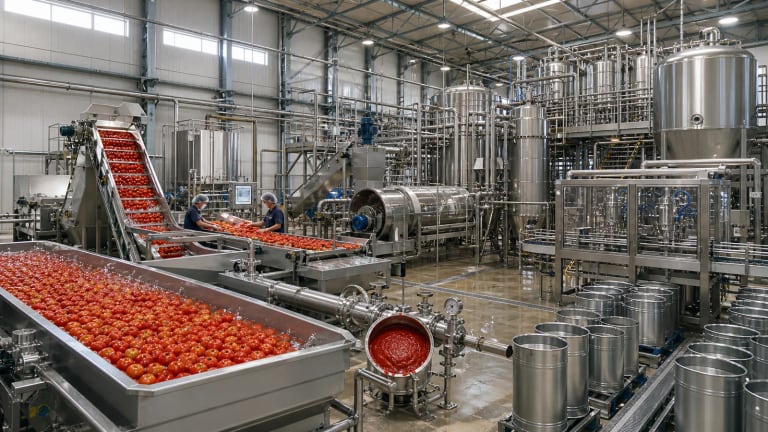
Turnkey tomato concentrate and aseptic filling solution
A seasonal industrial line for receiving fresh tomatoes, producing refined juice, vacuum concentration and validated aseptic bulk filling.
Supplier location
Türkiye
Guide type
Complete solution
Last reviewed
15 Jul 2026
AgriTech.tr prepared this explanation and comparison guidance.
Useful starting points, not a guaranteed final configuration.
Public sources support the technical overview. Current prices, availability, and commercial details still need confirmation.
Turnkey tomato concentrate and aseptic filling solution
Practical guides for projects that may include engineering, equipment, installation, and commissioning.
Configurable 2–50 t/h
Hot-break, cold-break or recipe-selectable configuration
Multi-stage pulper and refiner with selected screen sizes
Multi-effect vacuum evaporator sized to product and utilities
Product-selected 24–38 °Brix; Codex tomato paste starts at 24% natural soluble solids
Practical guides for projects that may include engineering, equipment, installation, and commissioning.
Applications and operating context for this solution.
Industrial tomato paste
Tomato puree and concentrate
Bulk ingredients for sauce factories
Seasonal tomato-processing plants
Confirm the supplier, final configuration, certifications, price, delivery, and warranty before you buy.
The sources, methods, and context used to prepare this page.
A seasonal industrial line for receiving fresh tomatoes, producing refined juice, vacuum concentration and validated aseptic bulk filling.
AgriTech.tr prepares this entry as a supplier-neutral technical sourcing scope so buyers can define a comparable request before suitable suppliers are researched and confirmed during sourcing. It does not reproduce a single vendor catalogue. Depending on the project, the potential scope may include local equipment and services or imported specialist components where technically necessary; the actual supplier and origin are confirmed during the quotation process.
The values below are not guaranteed single-model performance. They are typical, configurable procurement envelopes used to place competing quotations on the same engineering basis. Capacity, recipe, climate, water analysis, feedstock properties, target quality, utilities, and destination-country requirements are frozen in the final project schedule.
| Design item | Configurable procurement envelope | What the quotation must confirm |
|---|---|---|
| Fresh tomato intake | Configurable 2–50 t/h | The final value is verified against the feed/product, capacity, site data, acceptance method, and offered configuration. |
| Break process | Hot-break, cold-break or recipe-selectable configuration | The final value is verified against the feed/product, capacity, site data, acceptance method, and offered configuration. |
| Refining | Multi-stage pulper and refiner with selected screen sizes | The final value is verified against the feed/product, capacity, site data, acceptance method, and offered configuration. |
| Evaporation | Multi-effect vacuum evaporator sized to product and utilities | The final value is verified against the feed/product, capacity, site data, acceptance method, and offered configuration. |
| Final soluble solids | Product-selected 24–38 °Brix; Codex tomato paste starts at 24% natural soluble solids | The final value is verified against the feed/product, capacity, site data, acceptance method, and offered configuration. |
| Aseptic package | Configurable approximately 3–220 L | The final value is verified against the feed/product, capacity, site data, acceptance method, and offered configuration. |
| Cleaning system | Automated CIP with logged concentration, temperature and time | The final value is verified against the feed/product, capacity, site data, acceptance method, and offered configuration. |
The line or system boundary is documented through a responsibility matrix covering reception and infeed, process equipment, automation, safety, product discharge, utility interfaces, and data records. For brownfield integration, electrical single lines, piping and instrumentation, floor/loading data, drainage, ventilation, water quality, compressed air, steam, refrigeration, and network interfaces are reviewed before order.
Buyers should request at least three comparable quotations, references for similar installations in Türkiye, CE/conformity documentation, warranty boundaries, critical-spares lead times, and after-sales response commitments. This makes lifecycle cost, operability, and local service capacity visible alongside the purchase price.
The references support process principles and design boundaries; they do not certify a particular supplier’s performance. Final acceptance is based on the selected supplier’s written offer, project engineering, site review, and FAT/SAT protocol.
The sources, methods, and context used to prepare this page.
Independent or institutional technical reference used for process design, specification, and procurement acceptance boundaries.
Independent or institutional technical reference used for process design, specification, and procurement acceptance boundaries.
Independent or institutional technical reference used for process design, specification, and procurement acceptance boundaries.
See where the information came from and what must still be confirmed with a supplier.
Independent guide
AgriTech.tr prepared this explanation and comparison guidance.
Planning values
Useful starting points, not a guaranteed final configuration.
3 public sources
Public sources support the technical overview. Current prices, availability, and commercial details still need confirmation.
Supplier-provided claims
No supplier-provided claim is represented in this evidence profile.
Document-verified information
No underlying verification record is attached to this listing.
Listing images
No listing image is used as product evidence.
Food Processing, Value Addition & Byproduct Use
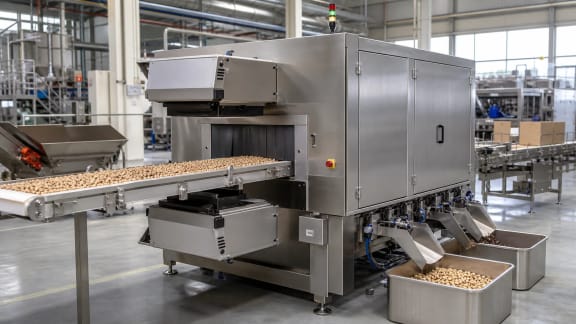
TürkiyeA conveyor-based inspection and sorting system combining X-ray detection, upper and lower RGB imaging, hyperspectral analysis and optional laser optics for foreign-material removal, defect classification, and quality sorting in dried fruit, nuts and processed foods.
Supplier and commercial terms require current confirmation