تقييم AgriTech.tr
صياغة تحريرية وإرشادات مقارنة أُعدّت للمساعدة في تحديد المتطلبات.
 AgriTech.trالتقنيات
التقنيات
أدلة شراء فنية ومواصفات توريد للمنتجات والمعدات الزراعية.
Root-zone sensing and irrigation monitoring equipment
A solar-powered LoRaWAN field system measuring soil moisture at three or four root-zone depths, with temperature sensing, optional EC measurement, IP68 probes, cloud and mobile monitoring, alerts, data export, and irrigation scheduling support.
 صورة توضيحية
منشأ التوريد
تركيا
نطاق المشتريات
مواصفة توريد
آخر مراجعة
13/07/2026
صياغة تحريرية وإرشادات مقارنة أُعدّت للمساعدة في تحديد المتطلبات.
نطاقات تخطيطية وليست تكوينًا نهائيًا مضمونًا.
تدعم المواد العامة السياق الفني؛ ولا تزال التفاصيل التجارية الحالية بحاجة إلى تأكيد.
Root-zone sensing and irrigation monitoring equipment
المعلمات الفنية المستخدمة لتحديد المتطلب ومقارنة التكوينات المؤكدة من المورّدين.
Solar-powered LoRaWAN root-zone monitoring with three- or four-depth probe architecture
Solar-powered LoRaWAN multi-depth root-zone soil monitoring for irrigation decision support
Three-depth configuration with 30/60/90 cm sensing and four-depth configuration with 30/60/90/120 cm sensing
The three-probe solar configuration: 30 / 60 / 90 cm; the four-probe solar configuration: 30 / 60 / 90 / 120 cm
0–100% volumetric water content reference range; soil-specific calibration and acceptance method are defined for the installation
المعلمات الفنية المستخدمة لتحديد المتطلب ومقارنة التكوينات المؤكدة من المورّدين.
تفاصيل عملية تساعد الأشخاص على مقارنة الخيارات.
Multi-depth root-zone soil-moisture monitoring in orchards and vineyards where irrigation teams need to compare wetting and depletion at 30–120 cm rather than relying on surface appearance alone.
Open-field irrigation scheduling for crops such as maize, cotton, wheat, or sunflower where sensor placement, management zones, soil texture, and the effective rooting depth are defined before installation.
Greenhouse and protected-crop monitoring where probe depths are selected and validated against the actual crop rooting volume and irrigation wetting pattern.
Smart-irrigation pilots that combine VWC trends, irrigation events, rainfall or weather data, crop stage, and water-meter records before moving to automated valve or pump control.
The four-probe solar configuration evaluations where 0–20 mS/cm EC monitoring may add salinity or nutrient-management context after the EC measurement basis and compensation method are confirmed.
Distributed LoRaWAN agricultural IoT networks where EU-868 configuration, gateway placement, antenna design, reporting interval, offline buffering, and field coverage are validated at the intended sensor locations.
Farm-management and integration workflows requiring mobile or web monitoring, threshold alarms, historical reports, CSV/JSON/Excel export, or REST API access with project-defined authentication, retention, and commercial terms.
تتطلب هوية المورّد والمنشأ والتوفر والتكوين النهائي والشهادات والسعر ومدة التوريد والضمان والتسليم وشروط العقد تأكيدًا حاليًا.
المنهج والمصادر والسياق المستخدم في إعداد صفحة البحث هذه.
This profile defines a sourcing requirement for multi-depth soil moisture and EC monitoring system. Suitable suppliers, origin, availability, and commercial terms are confirmed for the buyer’s project. The sourcing brief is structured around capacity, application, operating environment, required standards, destination, and delivery scope; the exact configuration requires supplier confirmation.
For farms, orchards, vineyards, and irrigation teams comparing wireless soil moisture sensors in Türkiye, successful field deployment depends on whether measurements represent the active root zone, whether the sensor response is understood in the local soil, whether the LoRaWAN network remains available across the production block, and whether the data can be converted into a repeatable irrigation decision.
The solar-powered root-zone monitoring system uses three- or four-depth probe configurations, LoRaWAN communication, a 5000 mAh rechargeable battery, integrated solar charging, IP68-rated field hardware, and mobile or web data workflows. The four-depth configuration can also include electrical-conductivity measurement. Probe depth, sensing principle, soil calibration, gateway coverage, reporting interval, alarm rules, and API scope are selected for the crop, rooting profile, irrigation method, and management zones.
The product should be evaluated as a root-zone monitoring and irrigation decision-support layer. Sensor readings do not automatically prove how much water a field needs, and a point sensor does not automatically represent an entire irrigation block. Probe placement, soil texture, salinity, root depth, crop stage, irrigation method, threshold design, and maintenance all influence whether the data becomes useful.
| Technical parameter | Three-depth configuration | Four-depth configuration | Project definition |
|---|---|---|---|
| Measurement depths | 30, 60, and 90 cm | 30, 60, 90, and 120 cm | Match depths to active roots, soil horizons, irrigation wetting pattern, and drainage risk. |
| Soil-moisture range | 0–100% VWC reference range | 0–100% VWC reference range | Define raw versus calibrated VWC, units, resolution, repeatability, and soil-specific field calibration. |
| Moisture performance | ±2% reference sensitivity | ±2% reference sensitivity | Define whether the value is accuracy, repeatability, resolution, or sensitivity and state the test method and soil conditions. |
| Soil temperature | -40°C to +80°C reference range | -40°C to +80°C reference range | State accuracy, resolution, response time, installation depth, and operating limits separately from range. |
| Electrical conductivity | Moisture-and-temperature configuration | Optional 0–20 mS/cm EC channel | Define bulk-soil versus pore-water EC, temperature compensation, moisture dependence, calibration, and agronomic interpretation. |
| Wireless communication | LoRaWAN with a 5 km planning reference | LoRaWAN with a 10 km planning reference | Complete an EU-868 radio survey covering terrain, canopy, antenna height, gateway diversity, packet delivery, and data recovery. |
| Power | Integrated solar panel and 5000 mAh battery | Integrated solar panel and 5000 mAh battery | Calculate winter energy balance, shading, panel fouling, battery chemistry, no-sun autonomy, low-voltage alarms, and replacement. |
| Field protection | IP68-rated field enclosure and probe assembly | IP68-rated field enclosure and probe assembly | Define the rating boundary for enclosure, connectors, cable glands, probe cables, mounting, and service openings. |
The wireless node uses LoRa modulation and LoRaWAN in the EU-868 band with a multi-channel gateway, internal or external antennas, encrypted onboarding, and up to four probe connections per field unit. Nominal point-to-point range can reach 5 km under suitable conditions, while the field enclosure is designed for approximately -40°C to +85°C operation. Final radio settings and coverage follow the site survey and acceptance test.
Each project uses a revision-controlled technical schedule covering probe construction, sensing principle, channel count, measurement depths, battery and solar package, enclosure, gateway, radio band, reporting interval, platform version, API scope, and warranty. The approved schedule and installation guide are attached to the order and become part of commissioning and acceptance.
A single surface reading can show that irrigation or rainfall has wet the upper soil while deeper roots remain dry. The reverse can also occur: the surface may dry quickly while usable water remains deeper in the technical specification. Multi-depth monitoring can help an irrigation team observe wetting-front movement, root-zone depletion, deep percolation risk, and the timing between irrigation events.
Probe depths such as 30, 60, 90, and 120 cm provide a useful multi-level root-zone profile, but the correct sequence depends on crop, plant age, soil horizons, irrigation geometry, and management objective. Shallow-rooted vegetables, young and mature orchards, maize, cotton, grapevines, and greenhouse substrates require different sensing depths and representative installation positions.
USDA Agricultural Research Service work on soil-moisture sensor placement also illustrates why depth selection is site-specific. In one seven-season sandy-loam study, a 30 cm observation was able to represent root-zone soil-water deficit at that research site, but the researchers explicitly identified transferability to other locations as a subject for further work. The practical lesson for buyers is not “install every sensor at 30 cm”; it is validate whether the selected depths represent the crop and soil technical specification in the actual field.
The sensing package covers a 0–100% VWC reference range. VWC is volumetric water content—the volume of water relative to a volume of soil—and becomes operationally useful when the sensor response is calibrated to local soil-water retention, active root depth, irrigation method, and management thresholds.
A practical commissioning workflow should establish or validate:
Wireless soil-moisture research from USDA ARS has used root-zone measurements and soil-water characteristic information to define irrigation thresholds in sandy-loam and clay-loam soils. That research used a different sensor technology and must not be presented as product validation for the multi-depth soil moisture and EC monitoring system; its relevance is the irrigation-management principle: thresholds depend on soil, crop, root depth, growth stage, and the water-retention relationship rather than on one universal moisture percentage.
Three-probe and four-probe solar configurations can be specified with a ±2% moisture-sensitivity reference value. The project data sheet must define whether this value represents accuracy, repeatability, resolution, or full-scale error, together with the calibration medium, soil conditions, temperature range, and test method.
Electromagnetic soil-moisture measurements are affected by soil texture, bulk density, salinity, temperature, installation contact, and calibration. USDA ARS evaluations of commercial sensors show that factory calibration can perform differently in saline or clay-rich soils. The project therefore states the sensing principle and uses a soil-specific field check against an agreed gravimetric, laboratory, or calibrated-reference method before irrigation thresholds are accepted.
The optional 0–20 mS/cm electrical-conductivity channel in the four-depth configuration can add salinity or nutrient-management context when its measurement basis is explicitly defined. The project specifies bulk-soil versus pore-water EC, electrode method, temperature compensation, moisture dependence, calibration, cleaning, units, and the agronomic interpretation used for decisions.
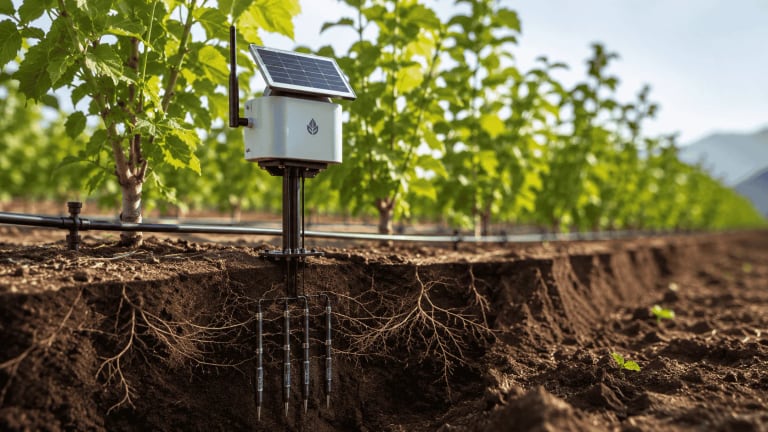
Root-zone and drip-irrigation context. Photo by Sercan Naya on Unsplash. Image source · Unsplash License.
The three-probe solar configuration has a 5 km LoRaWAN reference range, while the four-probe solar configuration has a 10 km reference range; open-area communication is engineered in the 5–10 km class with EU-868 operation, gateway selection, antenna placement, terrain, and link budget.
LoRaWAN uses regional radio parameters; the LoRa Alliance maintains the regional-parameter specifications that define region-specific radio settings. A device saying “EU-868” is therefore only one part of network fit. Buyers still need to confirm the gateway, network server, device onboarding method, antenna configuration, local radio design, and actual field coverage.
For an agricultural deployment, conduct a coverage survey at the intended sensor locations. Test during the season if crop canopy changes substantially. Record packet delivery or missing-data behavior at the farthest points, low areas, behind terrain, and around metal structures or greenhouse infrastructure. Ask what happens when connectivity is lost: whether measurements are buffered locally, how much history is retained, and how data is backfilled after reconnection.
Nominal 5 km and 10 km LoRaWAN design ranges are planning references, not guaranteed circles around a gateway. The radio design accounts for antenna height, terrain, canopy, greenhouse structure, soil-sensor placement, interference, duty cycle, spreading factor, and gateway diversity. Acceptance requires successful data delivery from every named installation point at the selected reporting interval.
The three- and four-depth configurations combine an integrated solar panel with a 5000 mAh rechargeable battery. A 45–60 day no-sun autonomy target can be used as a reference design condition; final autonomy is calculated from reporting interval, LoRaWAN airtime, signal quality, winter irradiance, shading, temperature, battery chemistry, aging allowance, and low-voltage behavior.
Before deployment, ask for:
Power autonomy is calculated from the 5000 mAh battery, solar-panel rating, reporting interval, radio airtime, winter irradiation, shading, battery chemistry, temperature, and aging allowance. The project defines a no-solar autonomy target, replacement interval, low-voltage alarm, panel-cleaning routine, and field procedure for safe battery replacement.
The platform provides web and mobile access to real-time sensor data, soil-moisture graphs, analysis and comparison tools, history, alarm thresholds, and automated-irrigation planning.
Platform functions include:
| Platform capability | Configurable workflow | Project acceptance |
|---|---|---|
| Live monitoring | Depth-specific moisture, temperature, and optional EC channels in charts and tables. | Verify sampling, local logging, upload interval, timestamps, units, quality flags, and stale-data indication. |
| Alarm thresholds | User- and role-specific threshold, rate, no-data, battery, and communications alerts. | Test delay, hysteresis, repeat logic, acknowledgement, escalation, offline behavior, and permissions. |
| Historical analysis | Daily, weekly, monthly, irrigation-event, rainfall, and crop-stage views. | Define retention, aggregation, timezone, resolution over time, annotations, and comparison periods. |
| Data export | CSV, JSON, XLSX, PDF, and project-specific scheduled reports. | Test a full export containing timestamps, device IDs, depth labels, units, quality flags, alarms, and maintenance events. |
| API integration | Authenticated REST API and optional webhook or bulk-data delivery. | Approve endpoint schema, authentication, quotas, versioning, retry behavior, webhooks, SLA, and commercial terms. |
| Irrigation workflow | Schedules, recommendations, and optional integration with valve or pump control. | Itemize controller hardware, command ownership, interlocks, manual override, fail-safe behavior, and automatic-control acceptance tests. |
| Multi-user access | Farm owner, agronomist, irrigation operator, integrator, and service roles. | Approve least-privilege access, audit logs, remote-support windows, account closure, and data ownership. |
This distinction matters: monitoring, irrigation advice, scheduling, and closed-loop automatic irrigation are different technical layers. A soil-moisture sensor may provide the measurement input, but automatic control also requires compatible field-control hardware, valve or pump interfaces, decision rules, network availability, fail-safe behavior, and manual override.
Water-saving and yield targets are established against a measured baseline for the actual farm. Results depend on the previous irrigation practice, climate, crop, soil, hydraulic uniformity, operator behavior, irrigation method, threshold strategy, and measurement method.
A serious field evaluation should record:
The strongest result is not “the dashboard looked drier.” It is a documented chain from sensor observation → irrigation decision → applied water → root-zone response → crop and operating outcome.
The strongest fit is a farm or irrigation team that wants continuous root-zone trends and is prepared to build irrigation rules around the data. Relevant use cases include orchard and vineyard irrigation, field crops such as maize or cotton, greenhouse soil monitoring, and distributed agricultural IoT networks where cabling and mains power are difficult.
For complex soil profiles, salinity conditions, large irrigation blocks, or automatic valve control, AgriTech.tr recommends defining the measurement, network, and irrigation-control architecture before comparing quotations.
For a soil-moisture, LoRaWAN, irrigation-automation, VWC/EC, or sensor-placement project in Türkiye, contact AgriTech.tr at info@agritech.tr. The sourcing brief can structure the technical requirement, network and sensor architecture, comparison fields, and site-acceptance criteria.
The cover and in-article photographs provide irrigation and root-zone context and are used under the Unsplash License. Photographer and source credits are retained in the reference section.
AgriTech.tr can structure the technical requirement and compare current supplier responses for the buyer’s project. Installation, commissioning, operator training, warranty, spare-parts, and after-sales scope must be confirmed in each supplier quotation. The final scope should be documented against the approved application, capacity, site conditions, destination, and delivery schedule in the selected supplier quotation and contract.
المنهج والمصادر والسياق المستخدم في إعداد صفحة البحث هذه.
Technical reference used for system specification, project engineering, and procurement planning.
Technical reference used for system specification, project engineering, and procurement planning.
Technical reference used for system specification, project engineering, and procurement planning.
Technical reference used for system specification, project engineering, and procurement planning.
Technical reference used for system specification, project engineering, and procurement planning.
Technical reference used for system specification, project engineering, and procurement planning.
Technical reference used for system specification, project engineering, and procurement planning.
Technical reference used for system specification, project engineering, and procurement planning.
Technical reference used for system specification, project engineering, and procurement planning.
Technical reference used for system specification, project engineering, and procurement planning.
المصادر المرجعية
توضّح المؤشرات مصدر المعلومات العامة وما لا يزال بحاجة إلى تأكيد. وهي ليست شارات اعتماد للمورّدين.
تقييم AgriTech.tr
صياغة تحريرية وإرشادات مقارنة أُعدّت للمساعدة في تحديد المتطلبات.
نطاقات هندسية نموذجية
نطاقات تخطيطية وليست تكوينًا نهائيًا مضمونًا.
10 مصادر عامة
تدعم المواد العامة السياق الفني؛ ولا تزال التفاصيل التجارية الحالية بحاجة إلى تأكيد.
ادعاءات مقدّمة من المورّد
لا يتضمن ملف الأدلة هذا أي ادعاء مقدّم من مورّد.
معلومات تم التحقق منها بالوثائق
لا يوجد سجل تحقق أساسي مرفق بهذا الإدراج.
صور الإدراج
الصور توضيحية وقد لا تُظهر التكوين النهائي الذي سيتم توريده.
Irrigation, Fertigation & Water Efficiency
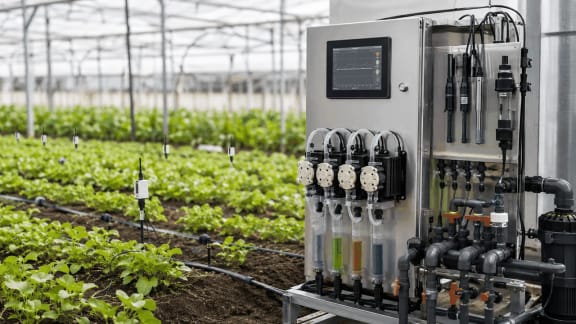
تركياAn integrated automation system for EC/pH-controlled fertilizer and acid dosing, crop-stage recipes, sensor-driven parcel irrigation, valve and pump sequencing, root-zone management, greenhouse climate interfaces, alarms, and operational reporting.
تتطلب هوية المورّد والشروط التجارية تأكيدًا حاليًا
Irrigation, Fertigation & Water Efficiency
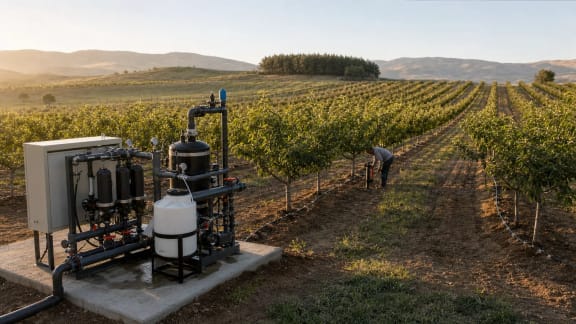
تركياA surveyed and hydraulically zoned drip-irrigation project combining source works, filtration and fertigation, mains, submains, pressure-compensating laterals, flushing, air relief, automation and agronomic scheduling for orchards and vineyards.
تتطلب هوية المورّد والشروط التجارية تأكيدًا حاليًا
