Independent guide
AgriTech.tr prepared this explanation and comparison guidance.
 AgriTech.trSolutions
Solutions
Practical guides for projects that may include engineering, equipment, installation, and commissioning.
Commercial hydroponic solution
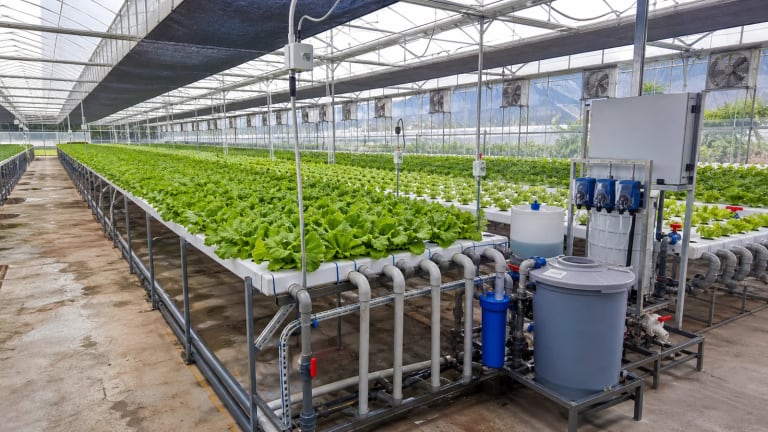
A crop-specific hydroponic greenhouse project using NFT, deep-water culture or substrate production with precise nutrient dosing, pH, EC and dissolved-oxygen monitoring, water treatment and optional nutrient-solution recirculation.
Supplier location
Türkiye
Guide type
Complete solution
Last reviewed
15 Jul 2026
AgriTech.tr prepared this explanation and comparison guidance.
Useful starting points, not a guaranteed final configuration.
Public sources support the technical overview. Current prices, availability, and commercial details still need confirmation.
Commercial hydroponic solution
Practical guides for projects that may include engineering, equipment, installation, and commissioning.
Typically configurable from 0.5 to 20 hectares
NFT, DWC, ebb-and-flow or substrate drip selected by crop and business model
Typically 5.5-6.5; final recipe is crop and water specific
Indicatively 1-3 dS/m for many crops, adjusted by crop and growth stage
Monitored continuously where relevant; lettuce guidance identifies more than 4 mg/L as important
Practical guides for projects that may include engineering, equipment, installation, and commissioning.
Applications and operating context for this solution.
Leaf lettuce
Culinary herbs
Hydroponic strawberries
Commercial leafy-green production
Confirm the supplier, final configuration, certifications, price, delivery, and warranty before you buy.
The sources, methods, and context used to prepare this page.
A crop-specific hydroponic greenhouse project using NFT, deep-water culture or substrate production with precise nutrient dosing, pH, EC and dissolved-oxygen monitoring, water treatment and optional nutrient-solution recirculation.
AgriTech.tr prepares this entry as a supplier-neutral technical sourcing scope so buyers can define a comparable request before suitable suppliers are researched and confirmed during sourcing. It does not reproduce a single vendor catalogue. Depending on the project, the potential scope may include local equipment and services or imported specialist components where technically necessary; the actual supplier and origin are confirmed during the quotation process.
The values below are not guaranteed single-model performance. They are typical, configurable procurement envelopes used to place competing quotations on the same engineering basis. Capacity, recipe, climate, water analysis, feedstock properties, target quality, utilities, and destination-country requirements are frozen in the final project schedule.
| Design item | Configurable procurement envelope | What the quotation must confirm |
|---|---|---|
| Project scale | Typically configurable from 0.5 to 20 hectares | The final value is verified against the feed/product, capacity, site data, acceptance method, and offered configuration. |
| Growing method | NFT, DWC, ebb-and-flow or substrate drip selected by crop and business model | The final value is verified against the feed/product, capacity, site data, acceptance method, and offered configuration. |
| Nutrient pH envelope | Typically 5.5-6.5; final recipe is crop and water specific | The final value is verified against the feed/product, capacity, site data, acceptance method, and offered configuration. |
| Nutrient EC envelope | Indicatively 1-3 dS/m for many crops, adjusted by crop and growth stage | The final value is verified against the feed/product, capacity, site data, acceptance method, and offered configuration. |
| Dissolved oxygen | Monitored continuously where relevant; lettuce guidance identifies more than 4 mg/L as important | The final value is verified against the feed/product, capacity, site data, acceptance method, and offered configuration. |
| Dosing | Typically 4-12 configurable stock, acid and base channels | The final value is verified against the feed/product, capacity, site data, acceptance method, and offered configuration. |
| Water hygiene | Filtration with optional UV, heat or other validated disinfection | The final value is verified against the feed/product, capacity, site data, acceptance method, and offered configuration. |
| Monitoring | Flow, temperature, pH, EC, tank level, DO and drain-volume records as applicable | The final value is verified against the feed/product, capacity, site data, acceptance method, and offered configuration. |
The line or system boundary is documented through a responsibility matrix covering reception and infeed, process equipment, automation, safety, product discharge, utility interfaces, and data records. For brownfield integration, electrical single lines, piping and instrumentation, floor/loading data, drainage, ventilation, water quality, compressed air, steam, refrigeration, and network interfaces are reviewed before order.
Buyers should request at least three comparable quotations, references for similar installations in Türkiye, CE/conformity documentation, warranty boundaries, critical-spares lead times, and after-sales response commitments. This makes lifecycle cost, operability, and local service capacity visible alongside the purchase price.
The references support process principles and design boundaries; they do not certify a particular supplier’s performance. Final acceptance is based on the selected supplier’s written offer, project engineering, site review, and FAT/SAT protocol.
The sources, methods, and context used to prepare this page.
Independent or institutional technical reference used for process design, specification, and procurement acceptance boundaries.
Independent or institutional technical reference used for process design, specification, and procurement acceptance boundaries.
Independent or institutional technical reference used for process design, specification, and procurement acceptance boundaries.
See where the information came from and what must still be confirmed with a supplier.
Independent guide
AgriTech.tr prepared this explanation and comparison guidance.
Planning values
Useful starting points, not a guaranteed final configuration.
3 public sources
Public sources support the technical overview. Current prices, availability, and commercial details still need confirmation.
Supplier-provided claims
No supplier-provided claim is represented in this evidence profile.
Document-verified information
No underlying verification record is attached to this listing.
Listing images
No listing image is used as product evidence.
Greenhouse & Protected Cultivation
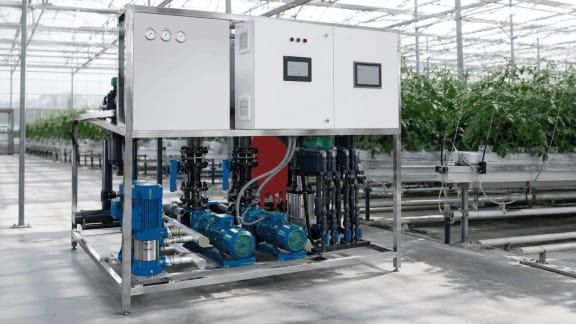
TürkiyeA modular greenhouse controller family integrating irrigation programs, EC/pH fertigation, valve and pump control, sensor inputs, event logging, remote access, alarms, and configuration-dependent ventilation, heating, fogging and screening functions.
Supplier and commercial terms require current confirmation
Greenhouse & Protected Cultivation
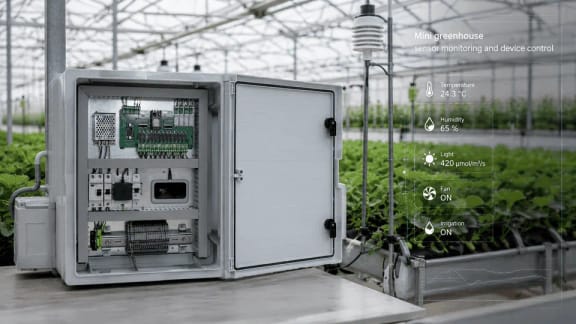
TürkiyeA compact greenhouse controller supporting up to eight sensor connections and twelve controlled devices, with mobile access, environmental monitoring, configurable automation rules, alarm functions, and weather-station integration for smaller installations.
Supplier and commercial terms require current confirmation
Greenhouse & Protected Cultivation
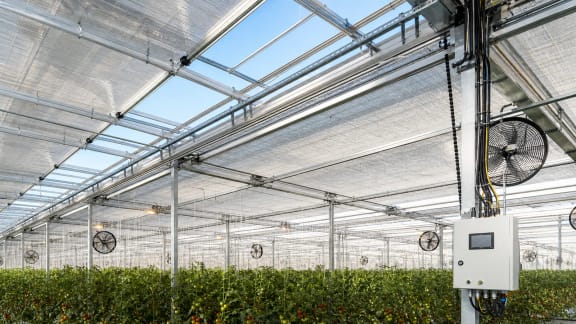
TürkiyeA retrofit-ready greenhouse subsystem combining one or more energy or shading screens, motorized roof and side ventilation, weather sensors, zone controllers, safety interlocks and manual override.
Supplier and commercial terms require current confirmation