Independent guide
AgriTech.tr prepared this explanation and comparison guidance.
 AgriTech.trSolutions
Solutions
Practical guides for projects that may include engineering, equipment, installation, and commissioning.
Containerized controlled-environment agriculture solution
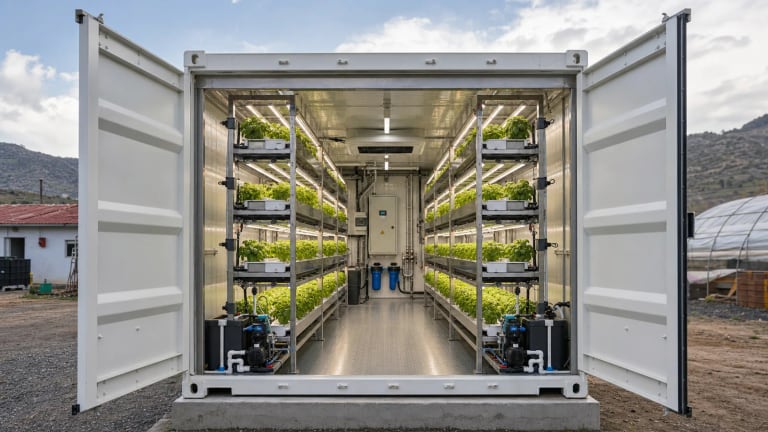
A containerized multilayer growing system for soilless crop production with environmental sensing, HVAC and humidity control, irrigation and nutrient delivery, LED grow lighting, remote records, electrical distribution, and commissioning options.
Supplier location
Türkiye
Guide type
Complete solution
Last reviewed
13 Jul 2026
AgriTech.tr prepared this explanation and comparison guidance.
Useful starting points, not a guaranteed final configuration.
Public sources support the technical overview. Current prices, availability, and commercial details still need confirmation.
Containerized controlled-environment agriculture solution
Practical guides for projects that may include engineering, equipment, installation, and commissioning.
Containerized soilless, multilayer controlled-environment cultivation
Temperature, humidity, light and CO2; exact sensors depend on package
Time-, layer-, moisture-, EC/pH-, drain-, and crop-recipe-informed irrigation with tank mixing, dosing, filtration, disinfection, and optional recirculation
entry, intermediate, and full-scope configurations with differing functions
Engineered for crop, racks, planting density, cycle time, yield target, lighting power, HVAC load, water treatment, labor, and destination climate
Practical guides for projects that may include engineering, equipment, installation, and commissioning.
Applications and operating context for this solution.
Containerized soilless and multilayer crop production
Controlled-environment crop trials and recipe development
Remote environmental, irrigation and lighting supervision
Local production projects with limited conventional growing area
Training and demonstration of indoor-farming workflows
Confirm the supplier, final configuration, certifications, price, delivery, and warranty before you buy.
The sources, methods, and context used to prepare this page.
This profile defines a sourcing requirement for containerized vertical farming system. Suitable suppliers, origin, availability, and commercial terms are confirmed for the buyer’s project. The sourcing brief is structured around capacity, application, operating environment, required standards, destination, and delivery scope; the exact configuration requires supplier confirmation.
The controlled-environment package manages temperature, relative humidity, CO₂, light, ventilation, and air circulation. Root-zone moisture, EC/pH, tank level, flow, and water-quality measurements can drive layer-specific irrigation and lighting, alarms, and remote access. Four-tier growing racks can be configured at entry, intermediate, or full automation scope; expanded packages add historical and crop records, nutrient preparation, tank mixing, ozonation, and optional solar-power integration. Each crop recipe defines day and night temperature, relative-humidity or vapor-pressure-deficit targets, photoperiod, photosynthetic photon flux density, daily light integral, CO₂ strategy, irrigation pulse volume and frequency, drain fraction, nutrient EC/pH, and growth-stage transitions. The mechanical design calculates sensible and latent cooling loads, dehumidification, condensation control, air velocity across every rack, filtration, heat rejection, fresh-air demand, insulation, vapor barrier, and door-opening recovery. The water system defines source treatment, storage, filtration, disinfection, dosing channels, return-water handling, drain monitoring, cleaning, and crop-change sanitation. Utility schedules record peak and average electrical load, water use, HVAC duty, backup power, fire protection, food-contact materials, maintenance clearance, consumables, and the destination-specific compliance package.
These are family and option descriptions. They do not show that every container includes every sensor, cultivation layer, nutrient unit or energy component. Obtain a signed room data sheet, process diagram and bill of materials for the exact package.
Start with the crop and market specification: cultivar, target harvest weight, planting density, germination method, cycle time, food-safety requirements and weekly output. Then request rack dimensions and usable canopy area; irrigation method and drainage; reservoir volume and water treatment; nutrient dosing channels; sensor make, range and calibration; lighting spectrum, PPFD map and photoperiod; HVAC sensible and latent capacity; dehumidification; CO2 source and safety; sanitation materials; pest exclusion; backup power; fire protection; and remote-platform data terms.
Indoor-farm economics are dominated by climate, light and labour. Ask for an hourly load schedule and a crop-specific mass balance covering electricity, water, nutrients, seed, labour, rejects and cleaning. Model performance for the destination climate rather than using a generic container estimate. A site-acceptance run should cover several complete crop cycles and measure uniformity across shelves, environmental stability, water use, energy per kilogram, saleable yield and downtime.
Water, time, labour, and production-hygiene targets are defined against the selected crop protocol, destination climate, equipment capacity, and measurable acceptance criteria. Price, lead time, certification, warranty, and export installation support are included in the project quotation.
AgriTech.tr can structure the technical requirement and compare current supplier responses for the buyer’s project. Installation, commissioning, operator training, warranty, spare-parts, and after-sales scope must be confirmed in each supplier quotation. The final scope should be documented against the approved application, capacity, site conditions, destination, and delivery schedule in the selected supplier quotation and contract.
The sources, methods, and context used to prepare this page.
Technical reference used for system specification, project engineering, and procurement planning.
See where the information came from and what must still be confirmed with a supplier.
Independent guide
AgriTech.tr prepared this explanation and comparison guidance.
Planning values
Useful starting points, not a guaranteed final configuration.
1 public source
Public sources support the technical overview. Current prices, availability, and commercial details still need confirmation.
Supplier-provided claims
No supplier-provided claim is represented in this evidence profile.
Document-verified information
No underlying verification record is attached to this listing.
Listing images
No listing image is used as product evidence.