 AgriTech.trResearch
Research
Topic maps, buyer references, taxonomies, and research files.
Milk Cooling Tank Manufacturers in Turkey: Capacity and Specification Guide
An evidence-led guide to 5 Turkish milk-cooling tank manufacturer groups, with published capacity scopes and practical rules for cooling duty, hygiene, refrigerants, testing and acceptance.

- Research cutoff: 2026-08-02
- Format: Verified buyer guide · 5-manufacturer alphabetical shortlist
- Equipment boundary: Refrigerated bulk milk tanks for farms and milk-collection points; processing/storage tanks without a defined cooling duty are outside the main comparison
- Capacity boundary: Small vertical farm tanks through high-capacity horizontal collection tanks
- Presentation: No paid placement, universal ranking or acceptance of supplier superlatives
Verification boundary: Every main-list company has a current Türkiye identity or factory trail and current manufacturer-controlled evidence of refrigerated milk-cooling tanks. Verification establishes public existence and documented scope at the cutoff. It is not a factory audit, credit report, sanctions screen, certificate approval, test of a specific model or endorsement. Published capacity, cooling class, refrigerant, energy, hygiene, export and service statements remain supplier claims until the offered serial-number configuration is documented and witnessed.
Türkiye offers milk coolers from compact 200–500 L farm units to horizontal tanks of 20,000–25,000 L. That range is commercially useful, but capacity alone is a poor buying criterion. A 5,000 L shell may fail the farm if it cannot cool the first milking without icing, reject heat at summer ambient temperature, drain and wash completely, record temperature reliably or obtain refrigerant service in the destination country.
This guide compares 5 Turkish manufacturer groups with current official evidence and separates 9 additional candidates. It is a specification guide, not a league table. The correct tank is the smallest verified system that receives every planned milking, completes the contracted cooling curve under the real ambient and inlet conditions, remains hygienic from low fill to full volume and can be serviced throughout its life.
Quick capacity answer
Do not size from herd count alone. Start with measured peak saleable milk, collection interval and the actual number of milkings stored. Then add growth and operating reserve without exceeding the tank’s tested usable volume.
| Buyer input | What to calculate or document | Why it changes the tank |
|---|---|---|
| Peak saleable milk per milking | litres after abnormal/treated milk diversion, at seasonal peak | establishes each warm-milk addition |
| Collection interval | hours, days and missed-collection contingency | establishes accumulated storage volume |
| Milking schedule | two, three or more milkings/day; robot/continuous inflow if relevant | changes batch size and cooling profile |
| Inlet temperature | after milking and after any plate pre-cooler | determines refrigeration duty |
| Design ambient | milk-room air at condenser, not regional average weather | determines heat rejection and compressor performance |
| First-fill/minimum volume | smallest milk volume covering the active cooling surface safely | prevents freezing and false performance assumptions |
| Growth and reserve | planned herd/process increase plus operational headspace | reduces premature replacement and overflow risk |
| Governing collection temperature | dairy contract and destination law | defines the acceptance target and alarm limits |
Use a transparent worksheet. If peak saleable output is Q litres/day, the normal collection interval is D days and the agreed design margin is M, preliminary required usable volume is Q × D × (1 + M). Replace daily values with per-milking batches when the test class depends on warm additions. Add a separately defined missed-pickup contingency only if the dairy and farm can safely operate it; do not hide contingency inside an unexplained oversizing factor.
Nominal volume, maximum working volume, calibrated volume and tested usable volume may differ. The bid must state each one. Headspace is needed for agitation, expansion, foam control and safe filling. A tank marketed as 2,000 L is not automatically entitled to receive 2,000 L of milk in every operating scenario.
Verified manufacturer comparison
| Manufacturer group | Published capacity scope | Configuration | Documented starting point | Main qualification issue |
|---|---|---|---|---|
| ARMAS Milking and Cooling Systems<br>Torbalı, Izmir | 200–10,000 L standard stationary range; 500–10,000 L mobile range stated by the manufacturer | Small open/vertical-type units, vertical and horizontal closed tanks, plus towable mobile units | AISI 304 construction, laser-welded roll-bond evaporator, automatic agitation; scale and automatic wash vary by series and capacity | Public pages still specify R404A and contain some legacy programme language. Obtain the current refrigerant, destination-market legality, exact test report, minimum milk quantity, cooling curve, electrical load and legal warranty entity for the offered serial-number range. |
| BF Intermak / MILKOL<br>Karatay, Konya | 100–10,000 L vertical and horizontal cylindrical farm coolers stated on the current product page | Vertical and horizontal direct-expansion tanks; manual or automatic control and optional automatic wash | AISI 304, roll-bond cooling surface, polyurethane insulation, DN50 outlet, CIP head, temperature/mixing controls and 220 V or 380 V variants | Do not convert the website’s family-level ISO/class statement into approval of every configuration. Require the test report and standard edition for the exact tank, plus minimum fill, ambient/inlet conditions, refrigerant circuit, cleanability and calibrated volume evidence. |
| Kromel / Peymak<br>Arifiye, Sakarya | Vertical 200–2,500 L; horizontal 2,000–25,000 L | Vertical direct-cooling tanks and large horizontal direct-expansion tanks with capacity-dependent agitator and refrigeration arrangements | AISI 304, laser-welded EP evaporator surface, polyurethane insulation, cleanable butterfly outlets, manual/automatic control options and model tables | Some product wording and brand labels are mixed across the Kromel/Peymak site. Freeze the invoicing manufacturer, brand, exact standard/test report and model revision. Validate large-tank low-fill operation, refrigeration staging, access, wash coverage and transport dimensions. |
| Kurtsan<br>Esenyurt, Istanbul | Vertical 100–2,000 L advertised; horizontal 2,000–16,000 L advertised, with a narrower set of sizes currently visible in the company store | Vertical compact tanks and horizontal higher-capacity tanks; exact open/closed architecture must be confirmed by model | Manufacturer pages document cooling-tank families and current sale listings; exact refrigeration method, minimum fill and performance class require the controlled model file | Treat the end capacities as enquiry sizes until quoted. The reviewed pages do not state enough to classify every model as direct or indirect cooling or to verify a common class. Obtain exact nameplate, standard/report, refrigerant, minimum fill, cooling curve, wash system and current A.S. invoice/warranty entity. |
| Sezer Milking Technologies<br>Karacabey, Bursa | Current pages document a 300 L vertical model and horizontal models from 2,000 through 12,000 L; request the complete current matrix | Vertical small-farm and horizontal closed tanks with optional or included washing/weighing depending on model | AISI 304, laser-welded heat-transfer plate, polyurethane insulation, geared agitator, DN50 outlet and model-specific compressor/control schedules | The product index contains duplicate capacity entries and variable wording. Require the exact model code, current drawing and tested configuration. Verify minimum milk level, cooling duty at design ambient, scale calibration status, refrigerant and destination service capability. |
Capacity scopes above reproduce current public manufacturer evidence; they are not independently measured production limits. “Published range” does not mean every capacity is stocked, tested under the same standard, available with the same wash system or legal with the same refrigerant in every destination.
How the shortlist was built
A main-list company needed current evidence of a Turkish manufacturer/factory identity, an actual refrigerated bulk-milk tank range, reachable official pages and enough technical content to distinguish a cooler from a passive stainless storage tank. Supplier groups are alphabetical. Factory size, export counts, “first,” “largest,” “leading” and unsupported efficiency claims were excluded from selection.
Company-controlled sources establish what a supplier publishes, not whether a tank achieves its claims. The procurement gates remain current registry and beneficial-owner checks, sanctions and financial screening where relevant, factory audit, exact test reports, model-specific declarations, reference calls and witnessed acceptance.
Manufacturer profiles
ARMAS Milking and Cooling Systems
Verified role. Turkish manufacturer of farm milk-cooling tanks, mobile cooling tanks, milking systems and stainless transport/storage equipment. Location: Torbalı, Izmir.
Published range. 200–10,000 L standard stationary range; 500–10,000 L mobile range stated by the manufacturer Small open/vertical-type units, vertical and horizontal closed tanks, plus towable mobile units
Documented specification starting point. AISI 304 construction, laser-welded roll-bond evaporator, automatic agitation; scale and automatic wash vary by series and capacity
Buyer fit. Farms and collection projects wanting a broad small-to-medium capacity range with milking and transport interfaces from one supplier.
What the public record establishes. ARMAS identifies Armas Tarim ve Hayvancilik Makineleri Sanayi ve Ticaret Ltd. Sti. in Izmir and publishes named MAST, DAST, YAST, SAST and RAST cooling-tank series. Current pages document individual capacities, cooling-class declarations, materials, power and wash/scale options.
Qualification caution. Public pages still specify R404A and contain some legacy programme language. Obtain the current refrigerant, destination-market legality, exact test report, minimum milk quantity, cooling curve, electrical load and legal warranty entity for the offered serial-number range.
Evidence reviewed: ARMAS - company identity and manufacturing scope; ARMAS - current milk-cooling tank range; ARMAS - 10,000 L model specification.
BF Intermak / MILKOL
Verified role. Turkish dairy and food machinery producer manufacturing MILKOL farm cooling, transport, storage and processing equipment. Location: Karatay, Konya.
Published range. 100–10,000 L vertical and horizontal cylindrical farm coolers stated on the current product page Vertical and horizontal direct-expansion tanks; manual or automatic control and optional automatic wash
Documented specification starting point. AISI 304, roll-bond cooling surface, polyurethane insulation, DN50 outlet, CIP head, temperature/mixing controls and 220 V or 380 V variants
Buyer fit. Farms, collection centres and dairies needing the cooler to connect with milk receiving, transport or a wider processing project.
What the public record establishes. The current corporate page states that the Konya company produces milk-cooling tanks under MILKOL and operates three factory buildings. Its live product page documents a 100–10,000 L family and states ISO 5708 2BII, direct expansion and optional automatic washing as manufacturer declarations.
Qualification caution. Do not convert the website’s family-level ISO/class statement into approval of every configuration. Require the test report and standard edition for the exact tank, plus minimum fill, ambient/inlet conditions, refrigerant circuit, cleanability and calibrated volume evidence.
Evidence reviewed: BF Intermak - current producer and factory scope; MILKOL - vertical cooling-tank range and specification; BF Intermak - farm equipment and cooling interface.
Kromel / Peymak
Verified role. Turkish dairy and food machinery manufacturer with Peymak-branded farm milk-cooling tanks and wider process engineering. Location: Arifiye, Sakarya.
Published range. Vertical 200–2,500 L; horizontal 2,000–25,000 L Vertical direct-cooling tanks and large horizontal direct-expansion tanks with capacity-dependent agitator and refrigeration arrangements
Documented specification starting point. AISI 304, laser-welded EP evaporator surface, polyurethane insulation, cleanable butterfly outlets, manual/automatic control options and model tables
Buyer fit. Buyers needing one of the broadest documented Turkish ranges, from small farm tanks to large collection/industrial coolers.
What the public record establishes. Kromel’s live site identifies Kromel Makine Sanayi A.S., an Arifiye manufacturing campus and the Peymak brand link. Current product pages enumerate capacities, construction, minimum milk quantities for selected models, cooling classes, electrical arrangements and washing scope.
Qualification caution. Some product wording and brand labels are mixed across the Kromel/Peymak site. Freeze the invoicing manufacturer, brand, exact standard/test report and model revision. Validate large-tank low-fill operation, refrigeration staging, access, wash coverage and transport dimensions.
Evidence reviewed: Kromel - current group and manufacturing identity; Kromel/Peymak - vertical 200–2,500 L range; Kromel/Peymak - horizontal 2,000–25,000 L range.
Kurtsan
Verified role. Turkish dairy-farm equipment manufacturer offering vertical and horizontal refrigerated milk-cooling tanks. Location: Esenyurt, Istanbul.
Published range. Vertical 100–2,000 L advertised; horizontal 2,000–16,000 L advertised, with a narrower set of sizes currently visible in the company store Vertical compact tanks and horizontal higher-capacity tanks; exact open/closed architecture must be confirmed by model
Documented specification starting point. Manufacturer pages document cooling-tank families and current sale listings; exact refrigeration method, minimum fill and performance class require the controlled model file
Buyer fit. Dairy-farm projects seeking cooling, milking, milk transfer and wider farm equipment from an established Turkish manufacturer/integrator.
What the public record establishes. Kurtsan’s current corporate site identifies its Turkish factory and the current company store identifies Kurtsan Tarim Endustri Makineleri Sanayi ve Ticaret A.S. Official product pages advertise vertical and horizontal cooling capacities, while active store listings corroborate a current subset of those models.
Qualification caution. Treat the end capacities as enquiry sizes until quoted. The reviewed pages do not state enough to classify every model as direct or indirect cooling or to verify a common class. Obtain exact nameplate, standard/report, refrigerant, minimum fill, cooling curve, wash system and current A.S. invoice/warranty entity.
Evidence reviewed: Kurtsan - current factory and manufacturer identity; Kurtsan - current vertical cooling-tank range; Kurtsan - current horizontal cooling-tank range.
Sezer Milking Technologies
Verified role. Turkish dairy-farm machinery manufacturer supplying milking, milk transfer, horizontal/vertical cooling and hygiene systems. Location: Karacabey, Bursa.
Published range. Current pages document a 300 L vertical model and horizontal models from 2,000 through 12,000 L; request the complete current matrix Vertical small-farm and horizontal closed tanks with optional or included washing/weighing depending on model
Documented specification starting point. AISI 304, laser-welded heat-transfer plate, polyurethane insulation, geared agitator, DN50 outlet and model-specific compressor/control schedules
Buyer fit. Farms seeking a cooling package integrated with Sezer milking, transfer, washing, tank weighing and service.
What the public record establishes. Sezer’s current site and manufacturer documents identify Sezer Tarim ve Sagim Teknolojileri San. Tic. Ltd. Sti. in Bursa. Live product pages publish vertical/horizontal categories and model data including capacity, class, wash, scale, materials, compressor and insulation.
Qualification caution. The product index contains duplicate capacity entries and variable wording. Require the exact model code, current drawing and tested configuration. Verify minimum milk level, cooling duty at design ambient, scale calibration status, refrigerant and destination service capability.
Evidence reviewed: Sezer - current legal identity and corporate scope; Sezer - horizontal 2,000–12,000 L product index; Sezer - detailed 10,000 L model.
Candidates requiring enhanced due diligence
| Candidate | Why enhanced due diligence is required |
|---|---|
| Anka Milking Technology | A current 2026 catalogue presents detailed vertical and horizontal cooling tanks from small farm sizes to 25,000 L and the live site gives a Konya address. The reviewed public pages did not expose the full legal manufacturer and factory identity. Obtain registry, invoice/warranty entity, factory evidence and exact EN 13732 test coverage. |
| Hinkon / Hinox Makina | The current site gives a Konya factory address and a detailed 300–10,000 L model/power table. The public file does not expose the full legal manufacturer, standard class, refrigerant or independent test record. Obtain registry, factory audit, nameplate identity and exact performance/conformity evidence. |
| Intermilk / AsyaFarm | A current legal name, Aksaray OSB factory and vertical/horizontal cooling categories are public. The reviewed web pages do not provide a coherent capacity, refrigeration-method or model-test matrix, so clarify whether the offered tank is manufactured in-house and freeze its nameplate, BOM and report. |
| Melasty / Ayaz Kaucuk | The current catalogue documents open vertical 100–2,000 L and closed horizontal 2,000–10,000 L tanks and a Bursa factory trail. Brand owner, manufacturer, exporter and warranty identities need reconciliation, and the reviewed material does not establish direct-versus-indirect cooling or exact test coverage. |
| SETUAY | The live site presents an Eskisehir production facility and current tanks up to 20,000 L. Its general and model pages contain conflicting range statements, legacy R404A wording and specifications requiring engineering review. Verify legal entity, controlled datasheet, test report, refrigerant compliance and references. |
| Sutkar | Live listings and a current catalogue establish an active Konya range, but advertised capacity scopes conflict and the public site does not clearly establish the legal entity or in-house tank manufacture. Obtain registry, factory/OEM, exact report and model schedule. |
| ENKA Tarim / Eurotanks | Official history states local open-tank production in Izmir, while the current catalogue also shows closed tanks. Turkish manufacture is not equally established for every closed model, and older attached material names a foreign manufacturer. Require current SKU nameplate, origin and warranty evidence. |
| Tekinox | The current catalogue presents Turkish dairy/food machinery manufacturing and milk-cooling equipment. Before main-list inclusion, verify the current legal entity, factory, farm bulk-cooler range, model-level performance test reports and whether refrigeration packages are made, integrated or resold. |
| Karatay Sogutma / Cengiz Karatay | The current Burdur site presents vertical 300–2,000 L, half-cylinder 2,000–3,000 L and horizontal 2,000–6,000 L tanks plus a production contact address. The legal identity appears to be a sole trade name and current model certificates were not located; verify registry, report scope and service capacity. |
Enhanced due diligence is not a negative finding. It means the reviewed public file did not yet support the same legal-manufacturer clarity, current model depth or ownership of the refrigerated tank as the main comparison. A candidate can qualify through registry documents, factory evidence, a controlled catalogue, exact performance reports and contactable installations.
Tank types: compare the operating system, not the silhouette
Open or compact vertical tanks
Small vertical tanks are space-efficient, accessible and commonly offered for lower volumes. A wide opening can simplify inspection and manual cleaning, but exposes milk if the lid, room and work practice are poor. Confirm the smallest safe batch, lid interlock, agitator guarding, splash protection, outlet drainability and whether the condenser has enough clear air path.
“Open” does not mean unprotected during operation. The design and procedure must prevent dust, insects, condensate, wash chemicals and hands from contaminating milk. A manual wash can be acceptable only when the procedure is repeatable, inspectable and supported by sufficient hot water, chemicals, drainage and labour.
Closed horizontal tanks
Horizontal tanks accommodate larger volumes and can offer enclosed storage, staged refrigeration, automatic washing, load cells and data logging. They require planned access to manways, agitators, valves, spray devices, sensors and refrigeration equipment. The milk room and delivery route must accept the tank’s shipping dimensions and future service envelope.
For a large tank, ask how each evaporator zone and compressor stage responds at first fill, intermediate batches and full load. More compressors can provide staging or redundancy, but only if controls, circuits and capacity are documented. Two compressors connected to one common weak point are not full redundancy.
Direct expansion, chilled water and ice-bank systems
Most reviewed Turkish public ranges describe direct expansion: refrigerant evaporates in a surface attached to the tank wall. It is compact and efficient when matched correctly, but the refrigeration circuit, refrigerant, minimum milk coverage and service competence are critical.
A chilled-water or ice-bank system separates cold generation from the tank and can shift electrical demand or serve plate cooling and multiple loads. It adds pumps, buffer volume, water quality, insulation and control interfaces. Do not compare a bare tank price with an integrated chilled-water plant. Define the system boundary and meter total energy.
Mobile cooling tanks
A towable tank combines food equipment, refrigeration, electrical systems and road/off-road structural risks. Confirm whether the tank is cooled while stationary only, how liquid surge is controlled, whether transport is permitted, how the generator or supply connects, and who certifies the chassis, brakes, lighting, mass and drawbar. ISO 5708 includes fixed or mobile farm/collection applications, while other standards may exclude mobile tanks; state the applicable test and legal framework explicitly.
Standards and the meaning of a cooling-class claim
ISO 5708:1983 was reviewed and confirmed in 2024, so it remains current at this guide’s cutoff. Its public scope covers automatically controlled refrigerated tanks for fixed or mobile farm/collection installation and two-milking (24-hour) or four-milking (48-hour) use. It addresses design, construction, performance and related testing but does not replace electrical-safety rules.
EN 13732:2022 covers performance, safety and hygiene for farm bulk milk coolers in its scope. Buyers should obtain the actual standard through the relevant national standards body and name the required edition in the purchase order.
A label such as “2BII” is not a complete acceptance criterion. Require the manufacturer to provide the full report for the exact model and configuration, naming:
- standard and edition;
- tank model, serial family and nominal/tested volume;
- milking/storage class and cooling-performance class;
- inlet and target temperatures;
- ambient temperature and condenser condition;
- first-fill and subsequent-fill quantities;
- cooling time and temperature uniformity;
- agitation, insulation and cleanability results where applicable;
- compressor, condenser, evaporator and refrigerant configuration; and
- test laboratory identity, report number, date and accreditation scope where claimed.
Never infer that every size in a catalogue inherits one report. A change in evaporator, compressor, refrigerant, control logic, insulation, agitator or geometry can change performance.
Cooling duty: write a curve, not “rapid cooling”
The refrigeration system must remove heat from incoming milk, heat leaking through insulation, agitator/motor input and repeated warm additions while operating at the design ambient. The supplier’s calculation should show milk mass, specific-heat assumption, inlet/target temperature difference, allowed time, ambient correction, compressor capacity at evaporating/condensing conditions and safety margin.
Specify a time-temperature curve for each critical batch. For example, define the initial volume at the start of milking, incoming flow or batch duration, inlet temperature, condenser-air temperature, target milk temperature and maximum time. If the farm adds warm milk to a cold retained volume, define the permitted temperature rise and recovery time. “Reaches 4°C” without those conditions is not comparable.
EU-bound supply chains must apply their actual legal and dairy-contract requirements. The current consolidated Regulation (EC) No 853/2004 states, subject to specified exceptions, immediate cooling to no more than 8°C with daily collection or 6°C when collection is not daily. A buyer or dairy may contract a lower target such as about 4°C. Do not present 4°C as the sole universal legal rule.
Cooling does not reverse contamination or antibiotic-residue failures. The Codex Code of Hygienic Practice for Milk and Milk Products treats hygienic production, handling, storage and transport as connected controls.
Plate pre-cooling changes the whole calculation
A plate heat exchanger using suitable cool water can lower tank inlet temperature and reduce compressor duty. It can also shorten recovery time and reduce peak electrical demand. Performance depends on milk and water flow, inlet temperatures, heat-transfer area, fouling and approach temperature.
Allocate responsibility for the plate cooler, water quality, filtration, pressure separation, flow control, temperature instruments and cleaning. Milk-to-water leakage must not contaminate milk. If pre-cooling performance is part of the tank sizing, contract its minimum outlet temperature under the actual water season and flow—not a laboratory assumption.
Recovered warm water may support animal drinking or wash-water preheating only after water-quality, temperature, storage and cross-connection risks are assessed. Include pumps and water treatment in lifecycle cost.
Minimum milk quantity and low-fill operation
Oversizing can be dangerous when the first milk does not cover the active evaporator or temperature sensor. Direct expansion may locally freeze milk while the bulk reading remains misleading. Robot or continuous-milking farms create different low-flow conditions from batch parlours.
Require minimum safe milk quantity for every active refrigeration stage, sensor location and control mode. The acceptance test must include the smallest realistic first batch, not only a near-full tank. Ask how the controller delays or stages cooling, prevents icing and responds to an agitator fault. Do not rely on a percentage copied from another capacity.
Milk-contact construction and drainability
“Stainless steel” is incomplete. Request material certificates for inner shell, outlet, valve, agitator, manway, spray device and other product-contact metal. AISI 304 is widely published in the reviewed ranges; AISI 316/316L may be offered for particular chemical or process conditions. Select grade from milk, water, cleaning chemistry, chlorides and destination requirements—not prestige.
Specify inner-surface finish, weld process and finishing, crevice control, gasket/elastomer declarations, drain slope and maximum retained liquid. Inspect the outlet, sensor pockets, agitator shaft/seal, manway, vents, spray shadows and every branch. “Zero residue” is a claim until demonstrated after level installation.
The outer jacket and chassis do not necessarily need the same grade as the milk-contact shell, but their material and corrosion protection must be declared. Mixed claims such as “full stainless” should be resolved with a component-by-component material schedule.
Agitation protects uniformity only when correctly controlled
Agitation should distribute temperature and milk components without excessive air incorporation, splashing or damage. Define agitator geometry, speed, motor/gearbox, duty cycle, low-level logic, lid/manway interlock and guard. One published rpm or motor wattage does not prove mixing in every tank size.
Acceptance should measure temperature at agreed locations and, where required, demonstrate representative sampling or composition uniformity. Verify restart after power loss and alarm behaviour after motor overload. Maintenance must be possible without contaminating the tank or leaving an unguarded rotating assembly.
Refrigerant is a procurement and lifecycle issue
Several current Turkish pages still advertise R404A. Do not describe a refrigerant as environmentally friendly merely because a catalogue does. Record refrigerant designation, charge, global-warming potential, circuit architecture, leak-detection needs, pressure ratings, availability and technician certification in both Turkey and the destination.
For EU projects, Regulation (EU) 2024/573 changes the placing-on-market and servicing environment for fluorinated greenhouse gases. Applicability depends on equipment type, date, capacity, refrigerant and market. The bidder must provide a destination-specific compliance statement and a service/retrofit plan; the buyer should obtain qualified legal and refrigeration advice rather than using this guide as a compliance opinion.
Natural or lower-GWP alternatives can introduce flammability, pressure, ventilation or training requirements. “Future-proof” requires an engineered safety case, available components and competent local service—not only a low GWP number.
Condenser, milk room and summer operation
Air-cooled condensers reject the removed milk heat into the milk room or outside air. A hot, dusty, poorly ventilated room raises condensing temperature, reduces capacity and increases energy use. State the design ambient at the condenser inlet, maximum recirculation, required airflow, clearance and fouling allowance.
Provide heat rejection and ventilation calculations. Protect outdoor equipment from sun, rain, animals and impact without blocking airflow. Locate the condenser so fins can be cleaned and compressors serviced safely. Test at a credible summer condition or apply a documented correction method.
Electricity, controls, alarms and records
The electrical schedule must state voltage, phase, frequency, full-load current, starting current, protection, isolator, cable and generator requirements. A catalogue horsepower value is not the site load. Include simultaneous compressors, agitator, wash heater/pumps, transfer pumps and milk-room ventilation.
Define control functions and fail-safe states: compressor staging, low-level protection, agitation, high/low temperature, sensor failure, phase loss, high pressure, wash lockout, power recovery and remote alarm. The farm needs a written response when power fails with warm milk in the tank.
Temperature records should be exportable, time-synchronised and protected against casual editing. Specify sensor type, calibration, accuracy, location, interval, storage period, alarm delay and backup. A bright display is not an auditable logger.
Volume measurement and payment use
Milk volume may be estimated with a calibrated dipstick/table or measured by load cells. Tank geometry, level, foam, temperature, installation and calibration affect the result. A displayed litre or kilogram is not automatically legal for trade or accepted for payment.
If settlement depends on tank measurement, name the applicable metrology rules, approval, calibration authority, sealing and verification interval. Otherwise label the value as operational indication and use the dairy’s accepted measurement method. Keep cooling control independent from a single payment-measurement failure where practicable.
Cleaning: manual, semi-automatic or validated CIP
Write the entire cleaning recipe: pre-rinse, alkaline wash, acid cycle where required, disinfection, any final rinse, drainage and release to service. Define water quality, volume, temperature at tank return, chemical identity/concentration, contact time, spray/flow coverage, agitator action, dosing accuracy and personal protection.
Automatic washing is not self-validating. Map spray coverage at the manway, roof, agitator, vents, sensors, outlet and shadows. Confirm detergent and rinse removal. Record each cycle and define alarms, rewash rules and what happens when water, heat, chemical or power is insufficient.
Manual tanks require safe reach without climbing into the vessel, clear inspection and protected tools. Entry into a large tank can become confined-space work; design cleaning and service to avoid entry where possible and apply destination safety rules.
Installation and milk-room design
Issue a scaled general arrangement before manufacture. Check shipping route, doors, turning radius, floor loading, feet/load-cell points, level tolerance, drain position, service clearances, manway opening, condenser air path, ventilation, lighting, washable finishes, pest control and tanker access.
Separate clean milk handling from manure, chemicals, fuel, dust and engine exhaust. Provide potable/suitable water as required, trapped drainage without backflow, safe chemical storage and protected electrical equipment for a wet environment. The tank outlet and tanker hose route should minimize exposure, trip hazards and retained milk.
Responsibility for the milking-line inlet, filter, plate cooler, transfer pump, tank valve, overflow, abnormal-milk diversion and tanker connection must appear in one interface matrix. Two suppliers saying “by others” can leave the cold chain incomplete.
FAT, SAT and performance proving
Factory acceptance should confirm the exact tank and serial number, dimensions, materials, weld/finish records, insulation, evaporator pressure/leak test, refrigeration components, refrigerant/charge, agitator, valves, sensors, controls, alarms, guards, wash system, documents and ordered spares. Witness functional tests and photograph nameplates without treating them as the performance test.
Site acceptance should verify installation, level/drainability, utilities, ventilation, electrical protection, controls, calibration, alarms, transfer/tanker interfaces and safe operation. Run the agreed cooling curve with water only if the protocol permits preliminary testing, then prove final performance with representative milk or an agreed medium under documented conditions.
The performance period should cover low fill, peak batch, repeated additions, wash cycles, hot ambient where feasible, power interruption and data export. Record inlet/ambient/tank temperatures, volume/mass, time, compressor stages, energy, faults and corrective actions. Define retest rights and remedies before the purchase order; link final payment to passed acceptance.
RFQ schedule buyers can copy
| Field | Required buyer/bidder data |
|---|---|
| Milk profile | species, peak saleable litres/milking and day, inlet temperature, seasonal growth |
| Collection | normal interval, missed-pickup plan, tanker connection and pickup window |
| Capacity | nominal, calibrated, maximum working and tested usable litres; reserve/headspace |
| Batch class | milkings stored, additions, first/minimum fill and robot/continuous flow if relevant |
| Cooling duty | complete time-temperature curve at stated inlet and design ambient conditions |
| Standard | exact ISO 5708 and/or EN 13732 edition, class, test report and model coverage |
| Tank | vertical/horizontal/mobile, dimensions, weights, access, feet/load cells and drainability |
| Materials | component-by-component grades, certificates, finish, welds, gaskets and valves |
| Refrigeration | compressor/evaporator/condenser, stages, refrigerant, charge, GWP and pressure tests |
| Pre-cooling | plate exchanger duty, water conditions, controls, cleaning and responsibility |
| Agitation | geometry, rpm, schedule, low-level logic, guarding, uniformity and alarm |
| Cleaning | manual/CIP recipe, water, heat, chemicals, spray coverage, records and validation |
| Measurement | temperature accuracy/calibration; volume/load-cell accuracy and legal status |
| Controls/data | alarm matrix, logs, export, backup, offline mode, remote access and ownership |
| Utilities | voltage/phase/frequency, running and starting loads, generator, water and drainage |
| Milk room | design ambient, heat rejection, ventilation, hygiene zoning and service clearances |
| Service | destination technicians, refrigerant competence, response, parts and remote support |
| Acceptance | FAT, SAT, cooling-curve test, low-fill test, wash validation, retest and remedies |
Require bidders to return a deviation schedule. Silence is not compliance. Freeze the bill of materials and country of origin for the shell, evaporator, compressors, controls, sensors, valves, agitator, wash system and load cells.
Compare lifecycle cost
Compare purchase, freight, access/civil works, installation, plate pre-cooling, ventilation, electrical upgrades, water, chemicals, energy, refrigerant service, calibration, planned parts, emergency response, downtime and replacement horizon. Measure kWh per accepted cooling cycle under comparable conditions rather than relying on an “efficient” label.
Oversizing can increase capital, wash water and low-fill risk; undersizing can miss temperature targets or force early collection. A plate cooler may lower refrigeration energy but raise water-treatment and pump costs. Automatic CIP may reduce labour while increasing controls and chemical dependency. Model the actual farm.
Buyer checklist before purchase order
- Verify legal manufacturer, seller, exporter, installer and warranty issuer.
- Reconcile brand ownership where a group and tank brand differ.
- Freeze peak milk, collection interval, growth and missed-pickup policy.
- State nominal, usable, calibrated and maximum working volumes.
- Specify minimum first fill and every warm-milk addition.
- Contract a cooling curve at inlet and condenser design conditions.
- Obtain the exact standard edition, class and model test report.
- Verify material certificates, finish, welds, gaskets and drainability.
- Confirm agitator uniformity, low-level logic, guard and interlocks.
- Validate manual cleaning or CIP coverage and chemical removal.
- Record refrigerant, charge, GWP, legality and destination service.
- Calculate condenser heat rejection and milk-room ventilation.
- Define power, starting current, phase protection and backup response.
- Specify calibrated temperature logging and data ownership/export.
- Clarify whether volume measurement is operational or legal for trade.
- Audit comparable tanks during filling, cooling, emptying and washing.
- Agree FAT, SAT, performance period, retest and remedies.
- Link final payment to verified performance and complete documents.
Common red flags
- Capacity offered with no milk profile or collection interval.
- “Cools to 4°C” without inlet, ambient, volume and time.
- A cooling-class code with no exact test report or model link.
- One report assumed to cover every capacity and refrigerant variant.
- No minimum milk quantity for direct-expansion cooling.
- R404A called “eco-friendly” with no destination-market plan.
- Compressor horsepower used as proof of cooling capacity or efficiency.
- “Full stainless” with no component material schedule.
- “Zero residue” with no level/drain test.
- Automatic wash with no water, heat, chemical and coverage record.
- Displayed litres treated as certified payment measurement.
- Condenser heat discharged into an unventilated milk room.
- Plate cooler savings assumed without water-temperature/flow data.
- Imported compressor/control parts with no local substitute or stock.
- Warranty begins at shipment instead of commissioned acceptance.
- Most payment due before cooling and wash tests.
How to choose—not rank—the manufacturer
There is no universal best milk-cooling tank manufacturer in Turkey. A 500 L compact tank may be ideal for a seasonal small-ruminant farm. A 5,000 L horizontal tank may suit a growing dairy with daily collection. A 20,000 L system may serve a cooperative only if refrigeration staging, low-fill behaviour, wash coverage, measurement and service are engineered for fluctuating intake.
Use pass/fail gates first: verified identity, usable capacity, cooling curve, exact test evidence, hygienic construction, safe refrigerant and electrical design, cleanability, calibrated records, installation engineering and destination service. Then compare lifecycle cost and references.
The winning offer is the tank that demonstrably receives the real milk profile, reaches the contracted temperature under design conditions, protects milk through storage and pickup, washes repeatably and remains serviceable—not the largest shell or strongest marketing claim.
Preparing a milk-cooling RFQ?
AgriTech.tr can convert milk volumes, collection schedule, climate, pre-cooling water, utilities, milk room, hygiene, measurement and destination requirements into a comparable sourcing brief. Use the AgriTech.tr sourcing workspace or email info@agritech.tr.
Supplier identity, technical compliance, price and commercial terms are re-verified during a sourcing project. This publication does not state that AgriTech.tr represents, certifies or pre-approves any listed company.
Corrections and review policy
This guide reflects public evidence accessible on 2026-08-02. Companies, brands, addresses, capacities, refrigerants, standards, models and service networks can change. AgriTech.tr welcomes documented corrections identifying the disputed statement, proposed factual correction and a current primary source. Verified material errors are corrected without giving suppliers editorial control. Inclusion or evidence class may change at review without implying endorsement or criticism.
Image rights and editorial disclosure
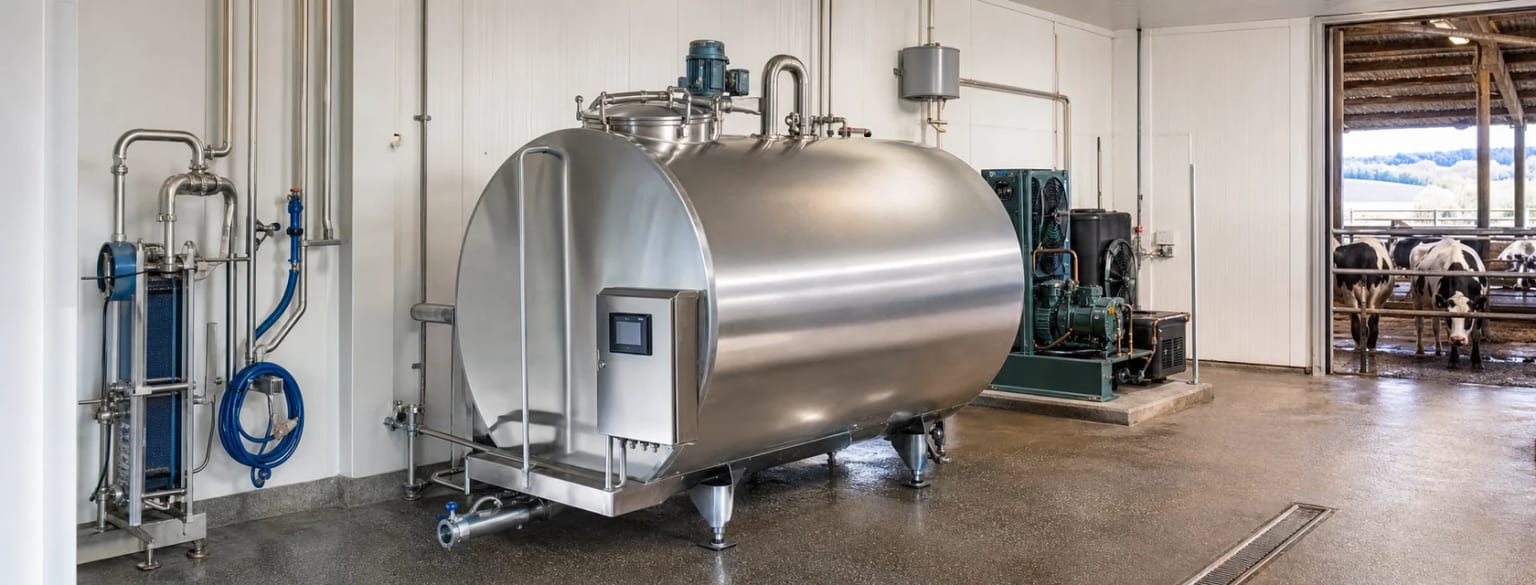
The cover is an original AI-assisted editorial visual created for this guide. It depicts a generic closed horizontal milk-cooling tank, refrigeration equipment, plate cooler and dairy milk room. It does not portray or endorse any supplier, model, factory, farm, customer or public institution. No catalogue photograph, supplier logo, trademark or branded design was copied.
How we researched this
The sources, methods, and context used to prepare this page.
Methods
How we researched this
External sources