 AgriTech.trResearch
Research
Topic maps, buyer references, taxonomies, and research files.
Dairy Equipment Manufacturers in Turkey: Complete Farm and Processing Solutions
A role-based guide to 10 verified Turkish dairy-equipment manufacturer groups, separating farm systems, processing plants, specialist machinery and turnkey integration.

Updated
2026-08-02
Tags
dairy equipment manufacturers Turkey, turnkey dairy plant
- Research cutoff: 2026-08-02
- Format: Verified buyer guide · 10-manufacturer role-based shortlist
- System boundary: Dairy-farm milking and cooling interfaces, raw-milk reception, processing, hygienic utilities, automation, cleaning and packaging integration
- Presentation: Alphabetical, non-paid and role-based; no universal ranking
Verification boundary: Every main-list company has a current Turkish legal, factory or institutional manufacturing trail plus current manufacturer-controlled product or project evidence. Verification confirms public existence and documented scope at the cutoff. It is not a factory audit, credit report, sanctions screen, certificate approval, reference acceptance or test of any offered line. Capacities, exports, installations, efficiency, conformity and service performance remain supplier claims until the exact contract package is documented and witnessed.
Executive answer
Türkiye has credible dairy-equipment manufacturers across three different roles: complete farm-to-processing suppliers, farm-side system manufacturers and processing-plant manufacturers or integrators. Those roles are complementary, not interchangeable.
Among the reviewed public evidence, BF Intermak / MILKOL has the clearest single-group span from milking and cooling through compact and conventional processing. GEMAK, STK Makina, Edelmak, Kromel, Teknoproses and Turkoz document substantial processing or collection-to-processing scope, but buyers must define which specialist packages are manufactured in-house and which are integrated from named OEMs. HOMMAK and Uzermak are valuable specialist manufacturers for pressure/homogenization and cheese/process duties respectively. Sezer is a strong farm-side system candidate and should be paired with a processor where the project continues beyond the bulk tank.
What “complete dairy equipment” actually includes
A dairy project is a chain of interfaces. Farm suppliers may stop at the bulk tank; process builders may start at reception; integrators may fabricate tanks locally while sourcing separators, homogenizers or fillers.
| Block | Required procurement evidence |
|---|---|
| Farm, milking and cooling | layout/animal flow, milking and wash calculations, usable cooling volume, cooling curve and OEM list |
| Reception and core process | unloading and sampling basis, mass balance, heat-treatment validation, composition/yield and records |
| Product and packaging | named recipes/SKUs, sustained saleable output, changeover, pack trials and OEM warranty |
| CIP, utilities and building | circuit matrix, peak utility balance, hygiene zoning, drainage, refrigeration and effluent loads |
| Controls and handover | functional design, traceability, data ownership, backup, tests, manuals, training and service |
“Turnkey” becomes meaningful only when the contract assigns civil works, utilities, laboratory, packaging, installation, commissioning materials, validation, permits and destination conformity.
Verified manufacturer comparison
| Manufacturer group | Verified role | Best-fit buying context |
|---|---|---|
| BF Intermak / MILKOL<br>Karatay, Konya | Farm-to-processing integrator | Small and medium farm-linked dairies wanting one Turkish counterparty for milking/cooling interfaces and a compact or conventional processing line. |
| Edelmak<br>Karatay, Konya | Turnkey processing manufacturer | Processing plants comparing a Konya-based builder for conventional dairy lines, stainless equipment, membrane/powder applications and automation. |
| GEMAK<br>Sincan, Ankara | Large turnkey process integrator | Medium and large greenfield, brownfield or export projects needing strong process engineering, stainless fabrication, automation and multi-vendor integration. |
| HOMMAK<br>Torbali, Izmir | Critical-process specialist | Dairies where homogenization pressure, capacity, product rheology, maintainability and local manufacture are decisive, including integration into a wider turnkey project. |
| Kromel Makine<br>Arifiye, Sakarya | Turnkey dairy-line manufacturer | Cheese- and fermented-product projects wanting a Turkish line builder with cooling/transport interfaces, stainless fabrication and automation capabilities. |
| Sezer Milking Technologies<br>Karacabey, Bursa | Farm-side system manufacturer | Greenfield and modernizing dairy farms that need a credible farm-side package before connecting to a separate collection or processing plant. |
| STK Makina<br>Arifiye, Sakarya | Broad turnkey dairy integrator | Greenfield and brownfield dairy projects seeking a single Turkish integrator across diverse product families and downstream filling/packing interfaces. |
| Teknoproses<br>Kahramankazan, Ankara | Process integrator with OEM partnerships | Processing projects that value Turkish engineering and service while deliberately integrating named European separation, homogenization or process components. |
| Turkoz Makina<br>Konya | Broad processing manufacturer/integrator | Dairy processors comparing a broad Konya engineering/manufacturing partner for heat treatment, tanks, CIP and product lines, with specialist OEMs added where required. |
| Uzermak<br>Torbali, Izmir | Cheese/process specialist | Cheese-focused dairies needing product-specific mechanical know-how, particularly pasta-filata, processed/analogue and natural-cheese applications. |
The table describes documented operating boundaries, not equivalent bids. It deliberately does not convert years in business, factory area, export-country counts, customer logos or “leading” claims into a quality score.
How the shortlist was built
Main-list inclusion required a current Turkish legal, factory or institutional trail plus first-party product/project evidence sufficient to identify the real operating boundary. Supplier pages do not prove performance; final qualification still needs corporate screening, factory audit, exact certificates/models, references and witnessed acceptance. Candidates with weaker public identity/factory clarity are separated for enhanced due diligence, not rejected.
Manufacturer profiles
BF Intermak / MILKOL
Evidence and boundary. Current official material identifies BF Intermak Makina Imalat Ithalat San. Tic. A.S., a Konya producer established in 1990, MILKOL-branded manufacture and three factory buildings. Current pages show farm equipment, milk coolers, processing machinery and product-specific turnkey lines rather than a generic trading-only catalogue. Role: Farm-to-processing integrator. The current catalogue explicitly says the group also purchases goods outside its own production range; every bought-in separator, homogenizer, filler, refrigeration package and control component therefore needs an OEM/responsibility schedule.
Buyer fit and qualification caution. Small and medium farm-linked dairies wanting one Turkish counterparty for milking/cooling interfaces and a compact or conventional processing line. Do not interpret one group brochure as proof that every line component is made in-house or performance-matched. Freeze the legal seller, origin, OEM, serial model, capacity, automation, food-contact file, FAT and destination service responsibility for each package.
Evidence reviewed: BF Intermak - current producer and scope; BF Intermak - current farm integration scope.
Edelmak
Evidence and boundary. The official site identifies Edelmak Makine Sanayi ve Ticaret A.S., a Konya address, machinery manufacture and a current machinery park. Its turnkey service page enumerates dairy product lines and project stages from design and production through commissioning and support. Role: Turnkey processing manufacturer. Current pages establish machinery manufacture and a documented machinery park, but each separator, homogenizer, dryer package, refrigeration set, filler and control component still requires an origin and responsibility schedule.
Buyer fit and qualification caution. Processing plants comparing a Konya-based builder for conventional dairy lines, stainless equipment, membrane/powder applications and automation. No current public page proves one common performance level across this broad portfolio. Require exact model and OEM schedules, process guarantees, factory references, food-contact documentation, hygienic design review, software ownership and witnessed product trials.
Evidence reviewed: Edelmak - current company identity; Edelmak - current machinery park.
GEMAK
Evidence and boundary. The official site names GEMAK Gida Endustri Makinalari ve Ticaret A.S., gives its Ankara OSB address and describes a 23,000 m2 site with a 15,000 m2 enclosed production facility. Current dairy and catalogue material enumerate complete lines, services and third-party integration roles. Role: Large turnkey process integrator. GEMAK publishes substantial in-house stainless/process manufacture while also identifying external principals for hygienic flow components, homogenizers/high-pressure pumps, separation, automation and other packages.
Buyer fit and qualification caution. Medium and large greenfield, brownfield or export projects needing strong process engineering, stainless fabrication, automation and multi-vendor integration. A broad farm-to-fork claim is not a single-source guarantee. Separate GEMAK-made equipment, licensed/represented equipment, nominated OEM packages and buyer-supplied utilities; require one signed responsibility matrix and performance guarantee across all interfaces.
Evidence reviewed: GEMAK - current legal identity and factory; GEMAK - current dairy turnkey scope.
HOMMAK
Evidence and boundary. The current official site describes in-house engineering, manufacturing, assembly and on-site commissioning and gives a Torbali production/contact address. Live model sheets and product pages establish active dairy-focused homogenizer, pump, mixer and filling activity. Role: Critical-process specialist. Official pages state domestic design and manufacture for core homogenizer, pump, mixer and selected filling products; upstream pasteurization, separation, tanks, CIP and complete packaging may require other parties.
Buyer fit and qualification caution. Dairies where homogenization pressure, capacity, product rheology, maintainability and local manufacture are decisive, including integration into a wider turnkey project. Marketing scale, country and customer counts are supplier claims. Qualify the exact legal manufacturer, model capacity at the stated product/pressure/temperature, valve and seal materials, CIP/SIP duty, pulsation, utilities, wear-part life and integration responsibility.
Evidence reviewed: HOMMAK - current manufacturer profile; HOMMAK - current dairy applications.
Kromel Makine
Evidence and boundary. The live site identifies Kromel Makine Sanayi A.S. and current dairy product groups, with institutional material describing three production factories and an R&D centre in Sakarya. Current equipment PDFs and service pages demonstrate active processing scope. Role: Turnkey dairy-line manufacturer. The public file establishes broad Sakarya-based equipment manufacture, but exact origin and responsibility still need to be scheduled for separators, homogenizers, refrigeration, fillers, instruments and proprietary automation components.
Buyer fit and qualification caution. Cheese- and fermented-product projects wanting a Turkish line builder with cooling/transport interfaces, stainless fabrication and automation capabilities. Line-family pages do not substitute for a guaranteed mass balance, yield, recipe, cleaning validation or packaging interface. Require model-level technical schedules, OEM list, current certificates and witnessed product trials for the contracted line.
Evidence reviewed: Kromel - current corporate and product scope; Kromel - current institutional profile.
Sezer Milking Technologies
Evidence and boundary. Current official pages identify Sezer Tarim ve Sagim Teknolojileri San. Tic. Ltd. Sti., two Turkish factories and an active product/project portfolio covering milking, transfer, cooling, hygiene and barn systems. Role: Farm-side system manufacturer. Official pages establish Sezer manufacture, while identified herd-management components and other specialist items may be partner/OEM products; country of origin must be confirmed per offered SKU.
Buyer fit and qualification caution. Greenfield and modernizing dairy farms that need a credible farm-side package before connecting to a separate collection or processing plant. Do not present Sezer as a complete dairy factory supplier. Identify every partner/OEM item, verify the current certificate file, freeze country of origin and connect the farm package to the processor through an agreed milk-quality, flow, cooling, transfer and cleaning interface.
Evidence reviewed: Sezer - current legal identity and factories; Sezer - current farm equipment scope.
STK Makina
Evidence and boundary. The live English site identifies a Sakarya 1st OSB factory, current manufacturing activity and a structured project path from planning through after-sales support. Its about and complete-facility sections enumerate actual dairy product lines rather than relying on an undifferentiated company description. Role: Broad turnkey dairy integrator. STK publishes integrated local manufacture, yet a component-by-component origin and OEM schedule is still required for separators, homogenizers, evaporators/dryers, refrigeration, fillers, instruments and controls.
Buyer fit and qualification caution. Greenfield and brownfield dairy projects seeking a single Turkish integrator across diverse product families and downstream filling/packing interfaces. Published history and export counts remain company claims. Require registry and beneficial-owner checks, factory audit, comparable running references, precise battery limits, process guarantee, OEM list, acceptance protocol and destination-country service plan.
Evidence reviewed: STK Makina - current English company and project scope; STK Makina - current about and turnkey line scope.
Teknoproses
Evidence and boundary. The current site identifies Teknoproses Muhendislik Danismanlik Makina Sanayi ve Ticaret Ltd. Sti. at an Ankara industrial address and presents factory, engineering, installation and service evidence. Current process pages provide specific equipment ranges rather than only generic claims. Role: Process integrator with OEM partnerships. The company discloses representation/integration relationships for ICE Group, Pieralisi and BOS, and its pasteurizer page identifies GEA components. The bid must distinguish Teknoproses fabrication from partner-OEM supply by line item.
Buyer fit and qualification caution. Processing projects that value Turkish engineering and service while deliberately integrating named European separation, homogenization or process components. Do not market the complete line as wholly Turkish-made when named packages are imported or partner-built. Require make, model, country of origin, nameplate manufacturer, warranty route, software licence, parts stock and single-point performance responsibility for every SKU.
Evidence reviewed: Teknoproses - current legal identity and factory contact; Teknoproses - current company and OEM relationships.
Turkoz Makina
Evidence and boundary. The Konya Chamber of Industry identifies Turkoz Makina Sanayi ve Ticaret A.S. and food/milk machinery manufacture. The active official site presents a current dairy process map, individual equipment pages and production/installation/service functions. Role: Broad processing manufacturer/integrator. Konya Chamber evidence supports food/milk machinery manufacture, while the current public file does not resolve the bowl/drive or pressure-end manufacturer for every separator and homogenizer, or a complete retail filling package.
Buyer fit and qualification caution. Dairy processors comparing a broad Konya engineering/manufacturing partner for heat treatment, tanks, CIP and product lines, with specialist OEMs added where required. Confirm the current delivery/factory address and legal seller. Require origin/nameplate and service responsibility for separators, homogenizers, controls and other specialist packages, and add a qualified filler/packer where retail packaging is outside the guaranteed scope.
Evidence reviewed: Konya Chamber - current Turkoz legal/manufacturing identity; Turkoz - current dairy process map.
Uzermak
Evidence and boundary. The official site identifies Uzermak A.S., a Torbali address and a current integrated manufacturing facility. Its product and application lists describe specific dairy machines and cheese families, plus installation and after-sales services. Role: Cheese/process specialist. The official product portfolio establishes in-house process machinery while farm systems, primary milk reception, separation, refrigeration and complete end-of-line packaging may require partner packages.
Buyer fit and qualification caution. Cheese-focused dairies needing product-specific mechanical know-how, particularly pasta-filata, processed/analogue and natural-cheese applications. Do not extrapolate cheese-specialist evidence into a complete farm-to-carton scope. Establish the raw-milk, pasteurization, separation, utility, automation, packaging and cold-chain packages supplied by Uzermak versus partners, with interface guarantees.
Evidence reviewed: Uzermak - current company, facility and product portfolio; Uzermak - current dairy and cheese machinery scope.
Candidates requiring enhanced due diligence
| Candidate | Why enhanced due diligence is required before comparison with the main list |
|---|---|
| Pastech | Current Konya pages show reception, cooling/transport, pasteurization, heat exchange, cheese/yogurt, CIP and turnkey-service activity. The reviewed file identifies only generic “Pastech Ltd. Sti.” wording and does not establish the exact legal/factory footprint as strongly as the main list; obtain registry and factory evidence. |
| Macronox / APA Agro | The live site advertises turnkey milk, cheese, yogurt, ayran, kefir and butter lines plus CIP and cold rooms. The reviewed public file did not establish the legal manufacturer, factory and in-house-versus-integrated boundary with the same clarity as the main list; obtain registry, factory and OEM evidence. |
| Milkaya | Current pages present dairy machinery and turnkey solutions, but legal identity, factory ownership and model-level technical evidence need stronger corroboration. Require registry, manufacturing audit, exact reference projects, origin schedule and performance acceptance before award. |
| Tekinox | A current catalogue presents Turkish dairy and food machinery, but the current legal entity, factory control, exact product ownership and line-level acceptance record require further corroboration. Confirm whether each offered package is manufactured, integrated, refurbished or resold. |
Enhanced due diligence should close four questions: who legally manufactures and warrants the equipment; where the offered package is made; which items are bought in, refurbished or resold; and which exact installations can be contacted and visited. A candidate can move into a competitive tender when those questions are answered with controlled documents.
Start with a product and volume basis—not a machine list
Issue a basis-of-design sheet before requesting price:
- milk species, seasonal composition/quality, inlet temperature, average/peak intake and tanker schedule;
- products, recipes, composition, packages, shelf-life route and destination;
- shifts, cleaning windows, batch/SKU sequence, yield/loss and future phase;
- utility peaks, building, hygiene zoning, drainage, climate and site limits;
- automation, traceability, language and enterprise interfaces; and
- applicable law, standards, tests, documents and training.
Capacity needs a reference product, conditions and unit. Litres per hour can change with viscosity, solids, pressure, temperature and cleaning state; tonnes per day may mean feed, curd, finished product or nominal batches.
Build and reconcile the mass balance
A reliable proposal converts incoming components—not just litres—into finished products, by-products, losses and cleaning transitions. The supplier should return a mass balance for every major recipe and the combined production week.
For each product family, document:
- raw-milk mass and composition;
- standardized milk, cream and skim streams;
- added ingredients, cultures, salt, water and packaging;
- product mass and target composition;
- whey, permeate, condensate, fines and recoverable product;
- start-up, shutdown, tank heel, line push and changeover loss; and
- effluent organic load and disposal or valorization route.
Do not accept a yield promise without its reference composition and measurement method. Cheese yield is sensitive to milk protein/casein, fat recovery, moisture, salt, fines and recipe. Separator performance depends on feed, temperature, throughput and machine setup. Powder recovery depends on evaporator and dryer conditions, fines return and cleaning. The contractual calculation needs calibrated measurement points and a reconciliation tolerance.
The mass balance sizes tanks, separators, heat exchangers, filling, CIP, cold rooms and wastewater. It also exposes a common error: selecting every machine at the same headline capacity while ignoring buffer time, batch residence, packaging speed and cleaning overlap.
Farm-to-factory interface
Where farm and processing packages meet, assign one interface owner. Define the last farm-side hygienic connection and first plant-side connection; hose/coupling standard; tanker and transfer pump duty; temperature and maximum hold time; sampling and rejection logic; volume/weight reconciliation; antibiotic and adulteration controls; cleaning responsibility; and data handover.
If the farm and processor are separate contracts, conduct a joint interface review before either purchase order. A high-capacity parlour can overwhelm a small cooler. A large bulk tank can create unsafe low-fill cooling. A fast reception line can entrain air, foam or exceed downstream chilling. A tanker connection can be physically compatible yet not drain or clean correctly.
For integrated farm projects, compare milk harvested per milking hour, not only cluster count. Confirm cow flow, vacuum reserve, milk-line sizing, receiver capacity, wash turbulence, hot-water recovery, chemical dosing, treated-milk segregation, outage response and cooling recovery at the true summer ambient. The dairy plant cannot repair poor raw-milk hygiene with later processing.
Raw-milk reception and cold chain
The reception block needs controlled sampling before commingling, acceptance/rejection logic, hygienic unloading, air removal where required, filtration or clarification, quantity measurement, rapid cooling or routing and traceable silo allocation.
For an EU-destination benchmark, the current consolidated Regulation (EC) No 853/2004 requires raw milk to be cooled immediately to no more than 8°C with daily collection or 6°C when collection is not daily, subject to its stated exceptions. During transport the cold chain must be maintained; the regulation also provides an arrival-temperature rule and post-acceptance cooling conditions with defined exceptions. These values are not a universal substitute for the destination law, dairy contract or validated process.
Specify:
- simultaneous and peak tanker unloading, including largest compartment;
- maximum pressure drop and acceptable shear/foaming;
- sampling location, device, flushing and chain of custody;
- temperature, conductivity/adulteration, residue and microbiological acceptance workflow;
- calibrated legal-for-trade measurement where commercial payment requires it;
- filter or clarifier differential-pressure monitoring and product-loss handling;
- silo allocation, overfill protection and independent high-high level;
- cooling duty at actual inlet and summer conditions; and
- rejected-milk containment that cannot reconnect accidentally.
ISO 707:2008 remains the published sampling standard for milk and milk products and can help define manual sampling, while applicable law and laboratory methods control acceptance. ISO 5708 remains relevant to refrigerated farm/collection bulk tanks, not to the entire factory process.
Separation, standardization and clarification
Separation and standardization control composition; they do not automatically pasteurize the product. Freeze feed temperature, flow, fat/solids range, cream target, skim loss, sludge discharge, start-up loss and cleaning method. If the separator is sourced from a third-party OEM, name the bowl and drive manufacturer, exact model, country of origin, local service route and warranty.
Where automatic standardization is required, define measurement accuracy, response, recirculation, off-spec diversion and reconciliation against laboratory results. A software screen showing a target percentage is not proof of achieved composition.
Clarification can remove physical material and some microbial load under validated conditions, but do not award a generic microbial “reduction” credit. Any food-safety control must be quantified for the specific machine, product and operating condition and integrated into the hazard-control plan.
Pasteurization: contract a validated process
For relevant EU dairy processes, Regulation 853/2004 identifies at least 72°C for 15 seconds, at least 63°C for 30 minutes or another time-temperature combination that achieves an equivalent effect. Where applicable it also refers to a negative alkaline-phosphatase reaction immediately after treatment, with specific provisions where that test is unsuitable.
These are process conditions, not a universal machine setting. Codex CXC 57-2004 links pasteurization to a performance objective and describes holding, flow and product considerations. Product viscosity, composition, fouling, flow regime and heat recovery can change performance.
The pasteurizer specification should include:
- reference and worst-case products;
- guaranteed flow range, not one nominal point;
- heating, holding and cooling temperatures;
- calculated and verified holding time at maximum flow;
- legal and process basis for diversion;
- pressure hierarchy preventing raw-side contamination of treated product;
- independent calibrated critical sensors and recorder;
- flow measurement or timing method used to enforce residence time;
- automatic safe-state behavior after temperature, flow, pressure, power or air failure;
- start-up, divert, recovery and shutdown product routing;
- heat-recovery basis, utility consumption and fouling allowance;
- cleanability of heat exchanger, holder, valves and branches; and
- an agreed validation and routine verification plan.
Do not accept “CE pasteurizer” as a thermal-process guarantee. CE marking concerns applicable product-safety law; it is not proof of microbial lethality, capacity, heat recovery, product quality or CIP outcome.
Homogenization and high-pressure packages
Homogenization changes fat-globule distribution and product stability; it is not a pasteurization step. Define the product, solids, viscosity, feed temperature, flow, first- and second-stage pressure, pressure stability, maximum particle size, aseptic requirement where relevant and expected analytical result.
For a homogenizer or high-pressure pump, compare:
- guaranteed capacity at the contracted pressure and product;
- wetted metallurgy, valve/seat/plunger materials and surface finish;
- pulsation, noise and vibration controls;
- lubrication and risk of product contamination;
- cooling-water and electricity demand;
- seal and wear-part life assumptions;
- change time, lifting tools and spare cartridge strategy;
- CIP/SIP flow, temperature, chemical compatibility and drainability;
- safety relief and guarded high-pressure components; and
- local competence for pressure-end rebuilding.
HOMMAK is a Turkish specialist candidate in this block. GEMAK and Teknoproses openly publish integration relationships with external OEMs. That transparency is useful, but the contract must still state whether the integrator or the nameplate OEM guarantees the result and responds at site.
Product-line requirements
| Product family | Minimum process definition |
|---|---|
| Pasteurized/UHT milk | standardization, homogenization, validated thermal duty, treated storage, cold-chain or aseptic boundary, filler and integrated sterility/availability test where applicable |
| Yogurt, ayran and kefir | milk preparation, ingredient mixing, heat treatment, culture dosing, fermentation endpoint, cooling, fruit/addition route, filling and incubation |
| Cheese and whey | named cheese, vat working volume, cut/curd handling, pressing or cooking/stretching, brining/maturation, yield and whey route |
| Cream and butter | cream target/recovery, heat treatment, maturation, churn or continuous duty, buttermilk route and packaging |
| Membrane and powder | feed variability, flux/concentration, cleaning recovery, evaporation water-removal duty, powder properties, fines, utilities and dust/fire protection |
A nominal tank is not a sellable batch: working volume, headspace, additions, agitation, sampling and transfer heel reduce it. UHT is not a high temperature typed into a normal pasteurizer; it needs a validated thermal and hygienic/aseptic system. “Cheese line” is not a specification—name the cheese and recipe. Treat whey as a measured product or by-product stream, not invisible wastewater.
Uzermak is a relevant cheese/process specialist; Kromel, STK, Edelmak, BF Intermak, GEMAK and Turkoz document broader product-line scope. Compare them on the buyer’s recipe, yield and packaging—not catalogue breadth.
Packaging is a process interface
A processor may integrate a third-party cup, pouch, bottle, carton or cheese packer. Freeze package material and tolerances; product temperature, viscosity and inclusions; sustained speed by SKU; fill accuracy and seal/reject limits; hygiene and cleaning; coding/inspection; change-parts and changeover; secondary packing; and the integrated warranty.
A filler free-running at catalogue speed is not proof of saleable output. Test the buyer’s product and approved packaging over a sustained period.
Hygienic design and food-contact evidence
“Made of 304 stainless steel” is not a hygienic design specification. Inspect product-contact materials, welds, finish, drainability, branches, valves, seals, instruments, agitators, spray devices, access and the ability to clean the real assembled line.
ISO 14159:2002 remains published but is marked by ISO for revision. EHEDG Guideline 8 reached a fourth edition in December 2025. Name the required edition and design criteria in the user-requirement specification rather than writing “according to international hygiene.”
For EU food-contact scope, Regulation (EC) No 1935/2004 establishes general requirements and traceability. Regulation (EC) No 2023/2006 covers good manufacturing practice for materials and articles intended to contact food. Specific measures, such as Regulation (EU) No 10/2011 for plastics, may add composition, testing and declaration requirements. Do not ask for one generic “food-grade certificate” and assume it covers metals, plastics, elastomers, lubricants, coatings and adhesives.
Request a component-level food-contact schedule with manufacturer, trade name, material, intended food, time/temperature/cleaning exposure, declaration or test basis and traceability. A written declaration of compliance is required where the applicable specific measure or national provision requires it; avoid claiming that one universal declaration rule covers every material.
Conduct a hygienic design review on the 3D model and again on the installed line. Confirm:
- product-contact surface finish and how it is measured;
- weld procedure, inspection, finishing and passivation;
- self-drain slope at final installation;
- maximum dead branches and valve-seat arrangement;
- gasket compression and elastomer compatibility;
- instrument pocket, sample valve and sight-glass cleanability;
- pump seal flushing or barrier arrangement;
- separation between product, CIP, water, air and drain;
- access for inspection and safe maintenance; and
- prevention of condensation, pests, glass/brittle material and foreign-body risks.
CIP: buy a validated cleaning system, not tanks on a skid
CIP performance depends on the complete circuits and objects, not the nominal volume of the CIP set. List every tank, line, heat exchanger, valve matrix, filler interface and mobile connection. Build a circuit matrix showing simultaneous cleaning, route, supply/return, worst hydraulic resistance and cross-contamination controls.
For each recipe, specify pre-rinse, chemical steps, intermediate rinse, disinfection or sterilization where required, final rinse and production release. Define time, temperature, chemical concentration, conductivity or other return criteria, supply/return flow, spray-device pressure, recovery/diversion logic and completion records.
The design should address:
- validated turbulent or otherwise effective flow for each pipe size and object;
- tank spray coverage at realistic pressure and flow;
- heat loss at the furthest return;
- chemical dosing accuracy and concentration verification;
- water quality, reused-rinse segregation and microbial control;
- product recovery before CIP;
- drainability and avoidance of chemical traps;
- operator exposure, bunding and incompatible chemical protection;
- recipe authorization, change history, alarms and aborted-cycle status; and
- post-CIP release criteria and periodic verification.
Codex CXC 1-1969 identifies monitored cleaning parameters such as time, temperature, pH, conductivity and chemical concentration depending on the system. EHEDG Guideline 50 addresses hygienic design and management of CIP installations, while Guideline 2 provides an in-place cleanability assessment method. These references support the URS; they do not validate the buyer’s installed plant automatically.
Utilities: issue a peak-load balance
“Utilities by customer” is incomplete. Require normal and peak demand, coincidence, quality, connection, pressure, temperature, return condition and metering at every battery limit.
| Utility | Contract boundary |
|---|---|
| Water | separate ingredient/final-rinse, potable, cooling, boiler-feed and non-potable duties; define point-of-use quality, peak flow and backflow protection |
| Steam/hot water | pressure, quality, treatment, direct-contact duty, condensate return and simultaneous pasteurization/CIP peak |
| Refrigeration | loads by process and ambient, refrigerant legality/safety, leak detection, ventilation, redundancy and destination service |
| Compressed air | instrument/contact/packaging points, hazard-based ISO 8573-1 class, treatment, monitoring and failure response |
| Electricity | connected/running/starting loads, voltage/frequency, earthing, protection and generator sequence |
| Drains/effluent | peak flow, temperature, pH, chemicals, fats, solids and organic load; whey/product-loss segregation and discharge limit |
CXC 1 requires water, ice and steam to be fit for intended use and not contaminate food. ISO 8573-1 does not select one universal “food-grade” compressed-air class. For refrigeration, name the exact applicable ISO 5149 edition and destination rules rather than citing the series generically.
Automation, data and ownership
An automated plant needs a functional description, not screenshots. Contract the PLC/SCADA architecture; recipe limits, versions and audit trail; calibrated critical sensors; time-temperature-flow/diversion and CIP records; batch genealogy; alarm logic; user and remote-access control; source-code/licence/password ownership; open data export; and a demonstrated backup/restore.
ISO 22005:2007 remains a published traceability reference. ISO 22000:2018 with Amendment 1:2024 remains the published food-safety management standard at the cutoff; a draft revision is not yet the normative edition. ISO 22002-1:2025 is the current food-manufacturing prerequisite-programmes standard. Certification to a management standard does not certify an individual machine’s capacity or hygienic design.
Machinery, pressure and destination compliance
Freeze a compliance matrix using destination, placing-on-market date and exact equipment. For EU supply at the cutoff, Machinery Directive 2006/42/EC remains applicable; Regulation (EU) 2023/1230 generally applies from 20 January 2027.
Assess as applicable ISO 12100 risk reduction and ISO 13849-1 safety controls; Pressure Equipment, Low Voltage, EMC and ATEX legislation; refrigeration/environmental rules; food hygiene/contact law; manuals, declarations and technical-file retention; and importer, representative and conformity-assessment roles.
Codex, ISO, EHEDG and 3-A documents are useful frameworks; they are not destination-market authorization. A 3-A Symbol is voluntary and valid only for equipment covered by a current authorization. Check the official certificate database and exact model rather than accepting a logo in a brochure.
Responsibility matrix: the most important turnkey document
Create a row for every system and interface and columns for process design, detailed design, manufacture, supply, installation, cable/pipe termination, software, testing, certification, training, warranty and performance. Assign one legally named party to each cell.
At minimum, resolve:
- separator, homogenizer and high-pressure pump OEM;
- refrigeration and chiller designer;
- boiler, water treatment and compressed-air package;
- CIP supply plus cleanability of every connected object;
- filler/packer and packaging-material approval;
- valve matrix, instrumentation, PLC/SCADA and enterprise interfaces;
- hygienic building panels, floors, drains and ventilation;
- cold rooms and warehouse handling;
- laboratory instruments and methods;
- wastewater pretreatment;
- spare parts and destination service; and
- integrated output, yield, hygiene and availability guarantees.
If two suppliers each exclude the interface, the buyer owns the failure. The commercial contract should establish a lead integrator with authority and liability across packages, even where specialist OEM warranties remain in force.
Comparing capacity without being misled
Ask each bidder to return a common line-balance table:
| Item | Required answer |
|---|---|
| Reference product and recipe | composition, viscosity, particles, inlet/outlet temperatures |
| Capacity definition | instantaneous, nominal, sustained good output or daily sellable output |
| Operating window | minimum/maximum flow or batch, turndown and low-level limits |
| Schedule | production hours, CIP, sterilization, changeover, maintenance and planned stops |
| Bottleneck | machine and SKU defining whole-line output |
| Utilities | normal/peak use at the guaranteed duty |
| Yield/loss | measurement boundary, start/stop and changeover allocation |
| Availability | formula, exclusions, observation period and data source |
| Future expansion | reserved nozzles, floor space, panel/I/O, utility and structural margin |
Overall equipment effectiveness can inform operation, but it must not hide a weak contractual definition. For acceptance, use simple measures: scheduled test time, good output, documented stops, rejected product, changeover time and agreed exclusions.
Request-for-quotation schedule
Send the same structured schedule to every supplier:
- Corporate file: legal title, registry, ownership, factory addresses, manufacturing licences, insurance, audited financial/credit information where appropriate, sanctions declaration and authorized signatory.
- Comparable references: same product family and scale, commissioning date, country, supplied battery limit, contact permission and achieved duty.
- Process package: design basis, flow diagrams, mass balance, line balance, equipment list, layout, room data, utility balance and effluent estimate.
- Equipment data: manufacturer, model, origin, materials, finish, working volume, duty, motor, instruments, safety and cleaning method.
- OEM matrix: every bought-in item, nameplate maker, local integrator, warranty, software, parts and service.
- Hygiene file: product-contact schedule, weld/finish standard, drainability, cleanability review, CIP matrix and validation proposal.
- Automation file: functional design, I/O, cause-and-effect, recipes, historian, traceability, cybersecurity, licence and backup.
- Compliance file: destination-law matrix, risk assessment, declarations, certificates, pressure/electrical/ATEX/refrigeration file and manuals.
- Project plan: design approvals, long-lead items, FAT, shipment, installation, SAT, commissioning, product trials, training and handover.
- Commercial file: currency, taxes, Incoterm, exclusions, payment milestones, securities, delay/performance remedies, warranty start and service rates.
Require a deviation schedule. “Complies” without a referenced document or calculation is not an answer. Silence should not be deemed acceptance of the buyer’s requirement.
Factory audit
Audit the legal factory building the order. Review engineering/document control, material traceability, forming/welding/finishing, weld and surface records, pressure/leak tests, panels/software, calibration, nonconformance, spares, subcontractor control and capacity for the promised schedule. For an integrator, audit OEM qualification and interface engineering. Country of origin is a fact, not a proxy for quality.
FAT, SAT and performance acceptance
No general certificate accepts a dairy line. Attach a test matrix with requirement, method, calibrated instrument, reference product, utilities, tolerance, sample plan, witness, record, retest and remedy.
- FAT: documents, nameplates/BOM, material/weld/finish evidence, dimensions, pressure/leak checks, panels and I/O, safety/interlocks, valve sequences, recipes, software backup and dry/water runs.
- SAT: installed utilities, levelling/drainability, pipework, electrical safety, loop/calibration checks, safe states, communications, CIP routing and building/refrigeration/packaging integration.
- Performance run: representative milk and packaging over a sustained period; saleable output, mass balance/yield/loss, thermal duty, composition, homogenization, product criteria, filling, CIP, utilities, effluent, changeover and availability.
A water run does not prove viscosity, yield, fermentation, filling or cleanability. Define who supplies trial materials and laboratory work. Link final payment and warranty start to signed acceptance, documents and training.
Documentation and training handover
Require approved process flows/mass balance, P&IDs/layouts, data sheets/drawings, material/weld/food-contact records, electrical and I/O files, functional description/software backup, risk and conformity file, test reports, operating/CIP/maintenance procedures and spares. Train operators, hygiene/quality, maintenance and automation teams on start-up, changeover, CIP, sampling, alarms, safe isolation, wear parts and data recovery.
Service and spare parts
Compare the legal warranty provider/start, destination response, secure remote support, technician competence, two-year operational/critical spares, wear-life assumptions, long-lead items, software/hardware compatibility, travel rates and post-warranty terms. Test parts availability with actual part numbers and ask references what happened after a failure.
Total cost of ownership
Use one production plan and period. Include delivered/installed plant, engineering and validation, all utilities, chemicals/effluent, product and packaging loss, labour/changeover, consumables, maintenance, specialist travel, downtime, finance/currency and expansion. Compare metered utilities per kilogram of saleable product at the same recipe, ambient, recovery and cleaning schedule.
Common red flags
- “Complete dairy plant” with no battery-limit or responsibility matrix.
- Farm equipment described as a processing factory, or vice versa.
- Every component implied to be Turkish-made despite disclosed external OEMs.
- A company group, brand and legal warranty entity treated as the same without documents.
- Capacity stated without product, solids, viscosity, temperature, pressure or packaging.
- Cheese or butter yield promised without a component mass balance.
- Pasteurization accepted from a temperature setpoint or CE logo.
- Homogenization treated as a microbial kill step.
- One “food-grade certificate” offered for every contact material.
- CIP tanks quoted with no circuit, hydraulic, temperature or concentration calculation.
- No minimum batch, turndown or first-fill behavior.
- Imported separator/filler with no nameplate, local service or parts route.
- Utilities marked “by customer” without quality and peak-demand data.
- Software password, source, licence and backups retained by the supplier.
- FAT limited to visual inspection or a short water run.
- SAT ends at mechanical completion with no product performance period.
- Warranty begins at shipment.
- Most payment falls due before integrated performance acceptance.
- Customer logos used instead of contactable comparable references.
- Expired, unrelated or model-unspecific certificates shown without scope.
How to choose—not rank—the supplier
There is no universal best dairy equipment manufacturer in Turkey. Apply pass/fail gates first:
- verified legal manufacturer/integrator and financial/compliance clearance;
- exact operating boundary and comparable references;
- accepted process basis, mass balance and line balance;
- hygienic design, food-contact and CIP solution;
- named OEMs, origin and one responsibility matrix;
- destination machinery, pressure, electrical and food compliance;
- realistic FAT, SAT and product-performance protocol;
- documentation, software ownership, training and service; and
- acceptable lifecycle cost and contract remedies.
Then score weighted project criteria. A farm-led project may weight animal flow, milking, cooling and rural service. A cheese plant may weight recipe/yield expertise. A UHT plant may weight aseptic integration and validation. A multinational brownfield project may weight automation standards and documentation.
The best offer is the one that converts the buyer’s real milk and recipes into safe, saleable products at the contracted yield and rate; cleans and records reliably; integrates every OEM and utility; and remains supportable in the destination market.
Preparing a dairy-equipment RFQ?
AgriTech.tr can convert farm scale, raw-milk profile, product portfolio, packaging, utilities, destination rules and commercial constraints into a comparable sourcing brief. Use the AgriTech.tr sourcing workspace or email info@agritech.tr.
Supplier identity, technical compliance, price and terms are re-verified during a sourcing project. This publication does not state that AgriTech.tr represents, certifies or pre-approves any listed company.
Corrections and review policy
This guide reflects public evidence accessible on 2026-08-02. Companies, legal names, addresses, factories, brands, products, OEM relationships, capacities, standards and service networks can change. AgriTech.tr welcomes documented corrections that identify the disputed statement, proposed factual correction and a current primary source. Verified material errors are corrected without granting suppliers editorial control.
Image rights and editorial disclosure
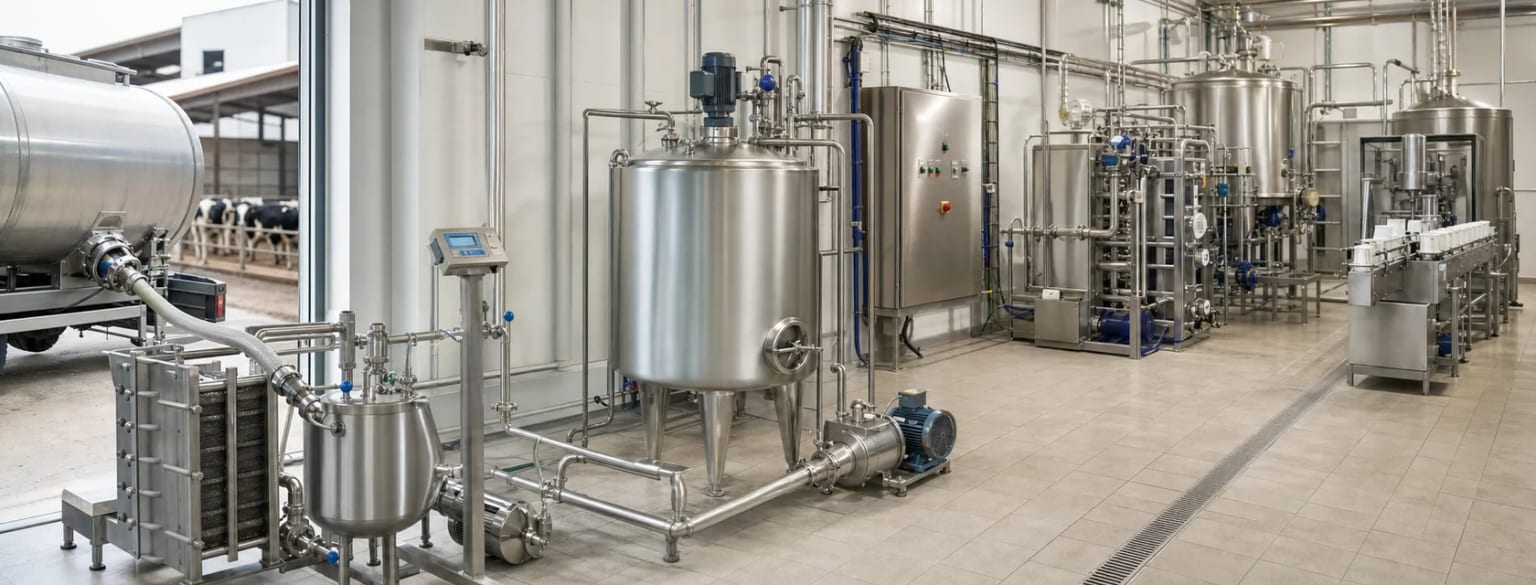
The cover is an original AI-assisted editorial visual created for this guide. It depicts a generic milk-reception and compact dairy-processing environment with a subtle farm context. It does not portray or endorse any supplier, machine, factory, farm, customer or public institution. No catalogue photograph, supplier logo, trademark or recognizable branded design was copied.
How we researched this
The sources, methods, and context used to prepare this page.
Methods
How we researched this
External sources