Independent guide
AgriTech.tr prepared this explanation and comparison guidance.
 AgriTech.trTechnologies
Technologies
Practical guides for understanding and comparing agricultural products and equipment.
Produce grading, packing automation and packhouse engineering
A crop-specific packhouse line integrating electronic and optical sorting, external and internal quality inspection, weighing, filling, packing automation, traceability, hydrocooling, pallet handling, line controls, and acceptance testing.
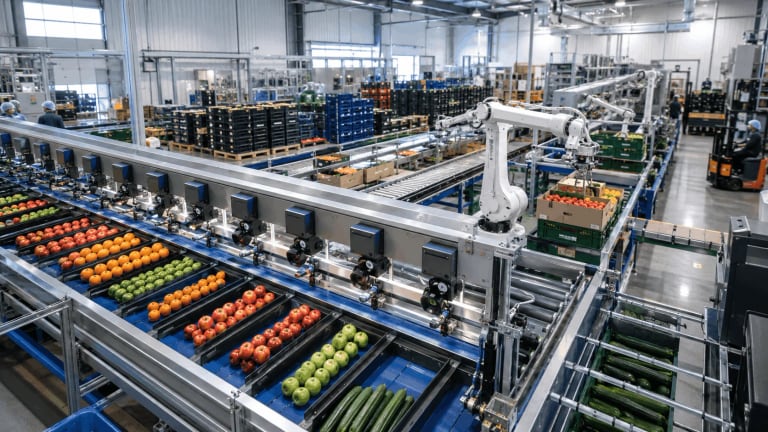 Illustrative image
Supplier location
Türkiye
Guide type
Buying guide
Last reviewed
13 Jul 2026
AgriTech.tr prepared this explanation and comparison guidance.
Useful starting points, not a guaranteed final configuration.
Public sources support the technical overview. Current prices, availability, and commercial details still need confirmation.
Produce grading, packing automation and packhouse engineering
The main technical details to review and confirm when comparing supplier options.
Crop-specific sorting, grading, packing, weighing, automation, and post-harvest systems, with the electronic grading and packhouse-automation layer electronic grading and packhouse technology context
Engineered fruit and vegetable packhouse lines spanning product reception, handling, grading, quality analysis, packing, and logistics
Cherry, blueberry, black fig, potato, onion, peach, apricot, nectarine, citrus, kiwi, apple, melon, watermelon, tomato, and other products validated through crop-specific testing
Mechanical sizing, load-cell weighing, diameter and color classification, RGB or multispectral external inspection, and near-infrared internal-quality analysis according to crop and module selection
The electronic grading and packhouse-automation layer catalogue includes multispectral imaging, 360-degree fruit presentation, AI-assisted classification, and optional UV inspection modules analysis on supported products
The main technical details to review and confirm when comparing supplier options.
Practical details that help people compare options.
Fresh-fruit and vegetable packhouses designing or replacing reception, handling, sizing, electronic grading, quality-analysis, packing, and end-of-line logistics systems.
Export-oriented operations that need repeatable size, color, external-defect, internal-quality, weight, count, pack-presentation, label, and traceability rules translated into a machine acceptance specification.
Cherry, blueberry, black fig, stone-fruit, citrus, kiwi, apple, melon, watermelon, tomato, potato, and onion operations comparing crop-specific line architecture rather than purchasing a generic grading machine.
Facilities evaluating external multispectral or AI-assisted optical sorting and internal near-infrared quality analysis where defect libraries, calibration, false rejects, missed defects, and module-specific throughput must be tested.
Packing operations comparing box filling, weighing, netting, clipping, conveyors, robotic packing, pallet wrapping, strapping, palletizing, and internal logistics as separate automation layers.
Cold-chain projects considering cherry hydrocooling, product temperature reduction, closed-loop water, filtration, optional disinfection, and downstream cold-store integration.
Existing packhouses planning a retrofit where footprint, utilities, drainage, hygiene zones, labor stations, maintenance access, product drop heights, packaging supply, finished-goods buffers, and installation downtime are major constraints.
Packhouses specifying lot genealogy, barcode or RFID workflows, reception-to-dispatch traceability, ERP/WMS integration, labels, stock control, data exports, backups, and remote-support access.
Procurement teams preparing FAT and SAT protocols for sustained throughput, grade accuracy, handling damage, reject/rework routing, packing performance, traceability, fault recovery, and documentation.
Seasonal operations where stocked spares, remote assistance, local technical service, critical-parts planning, operator training, and peak-harvest escalation procedures affect investment risk.
Confirm the supplier, final configuration, certifications, price, delivery, and warranty before you buy.
The sources, methods, and context used to prepare this page.
This profile defines a sourcing requirement for optical produce grading and packing line. Suitable suppliers, origin, availability, and commercial terms are confirmed for the buyer’s project. The sourcing brief is structured around capacity, application, operating environment, required standards, destination, and delivery scope; the exact configuration requires supplier confirmation.
For a fresh-produce packhouse, a grading line is not simply a conveyor with a camera. The engineering problem starts with crop physiology, incoming product variability, defect definitions, required grade categories, target throughput, packaging mix, cold-chain timing, data traceability, and peak-season service risk.
The practical buyer question is therefore: which exact modules are engineered into the quoted line, for which crop and quality specification, and how will the complete facility be tested before peak harvest?
| Process layer | Technical solution scope | Project definition and acceptance |
|---|---|---|
| Reception and infeed | Bin and case reception, controlled tipping, depalletizing, accumulation conveyors, crop-specific singulation, and metered infeed. | Bin or case type, tipping method, fruit drop heights, incoming temperature, foreign-material risk, and maximum arrival rate. |
| Washing and pre-conditioning | Washing, drencher treatment, brushing, waxing, drying, hydrocooling, filtration, and sanitation modules selected for the crop. | Water quality, chemical compatibility, contact time, temperature, drainage, residue control, and changeover cleaning. |
| Sizing and grading | Mechanical sizing, load-cell weighing, electronic grading, color and diameter classification, and external or internal quality analysis. | Grade rules, size bands, weight tolerance, color thresholds, defect taxonomy, reject routing, and calibration samples. |
| Optical and internal analysis | RGB or multispectral external inspection, AI-assisted classification, UV options, and near-infrared BRIX, acidity, or internal-defect analysis. | Sensor package, crop and variety, defect library, illumination, model tuning, false-reject and missed-defect limits, and seasonal recalibration. |
| Packing and weighing | Count or weight filling, netting, clipping, box or crate filling, packing conveyors, fruit orientation, and robotic packing options. | Pack type, nominal weight or count, giveaway tolerance, tray or box dimensions, label position, rework route, and packs per hour. |
| End-of-line logistics | Palletizing, wrapping, strapping, finished-goods conveying, buffering, and cold-store or dispatch interfaces. | Pallet pattern, load stability, forklift or AGV interface, finished-goods buffer, and dispatch sequence. |
| Traceability and software | Reception-to-dispatch lot records, barcode, QR or RFID identification, ERP/WMS integration, reports, intermediate-stock control, and automated logistics. | Batch genealogy, label standards, API or export format, retention, user roles, audit trail, backups, and data ownership. |
| Commissioning and lifecycle support | Factory and site acceptance, operator training, preventive maintenance, remote support, critical spares, warranty, and peak-season service planning. | FAT, SAT, training records, spare-parts package, secure remote access, escalation path, response time, and software support. |
The line can be configured for:
This crop list matters because a line designed around apple handling should not be assumed to fit cherries, blueberries, figs, nectarines, onions, or citrus without a new technical review. Fruit diameter, shape, stem behavior, skin sensitivity, firmness, surface moisture, temperature, defect visibility, and packaging rules can change the required singulation, transport, camera, ejection, weighing, and packing architecture.
A representative apple-grading configuration is designed around an average capacity of 5 tonnes per hour with 20-program recipe memory, inverter-controlled conveyor speed, load-cell weighing, alarm diagnostics, sensor-controlled positioning, and stainless-steel product-contact conveyors. Actual sustained capacity is established with the specified apple size distribution, infeed quality, grading rules, packing format, and allowable handling damage.
A 5 t/h apple-grading reference configuration is meaningful only with its stated fruit-size distribution, inlet quality, lane count, grade split, packing mix, staffing, operating hours, and permissible handling damage. Final line capacity is defined as a sustained acceptance-test result for the buyer’s actual product and pack specification.
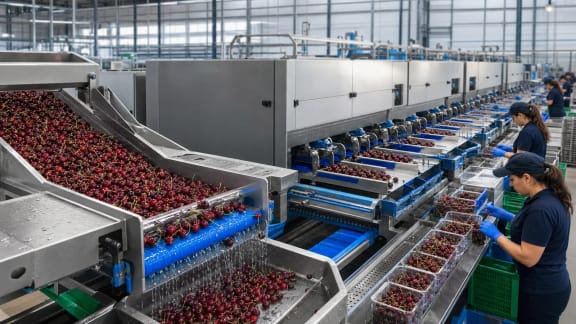
Cherry sorting can use direct packing or a two-stage pre-sizing and packing process. A full-surface optical inspection module can rotate and image the fruit for cosmetic-defect classification; the acceptance test defines defect classes, surface coverage, false rejects, missed defects, and sustained throughput.
Full-surface camera presentation means the handling and imaging geometry is designed to expose the fruit surface to the inspection system; it does not by itself guarantee perfect defect detection. Factory acceptance therefore uses a defect-by-defect test set covering cracks, bruising, color, softness, stem condition, pitting, doubles, undersize fruit, and the buyer’s export specification, with agreed detection and false-reject thresholds.
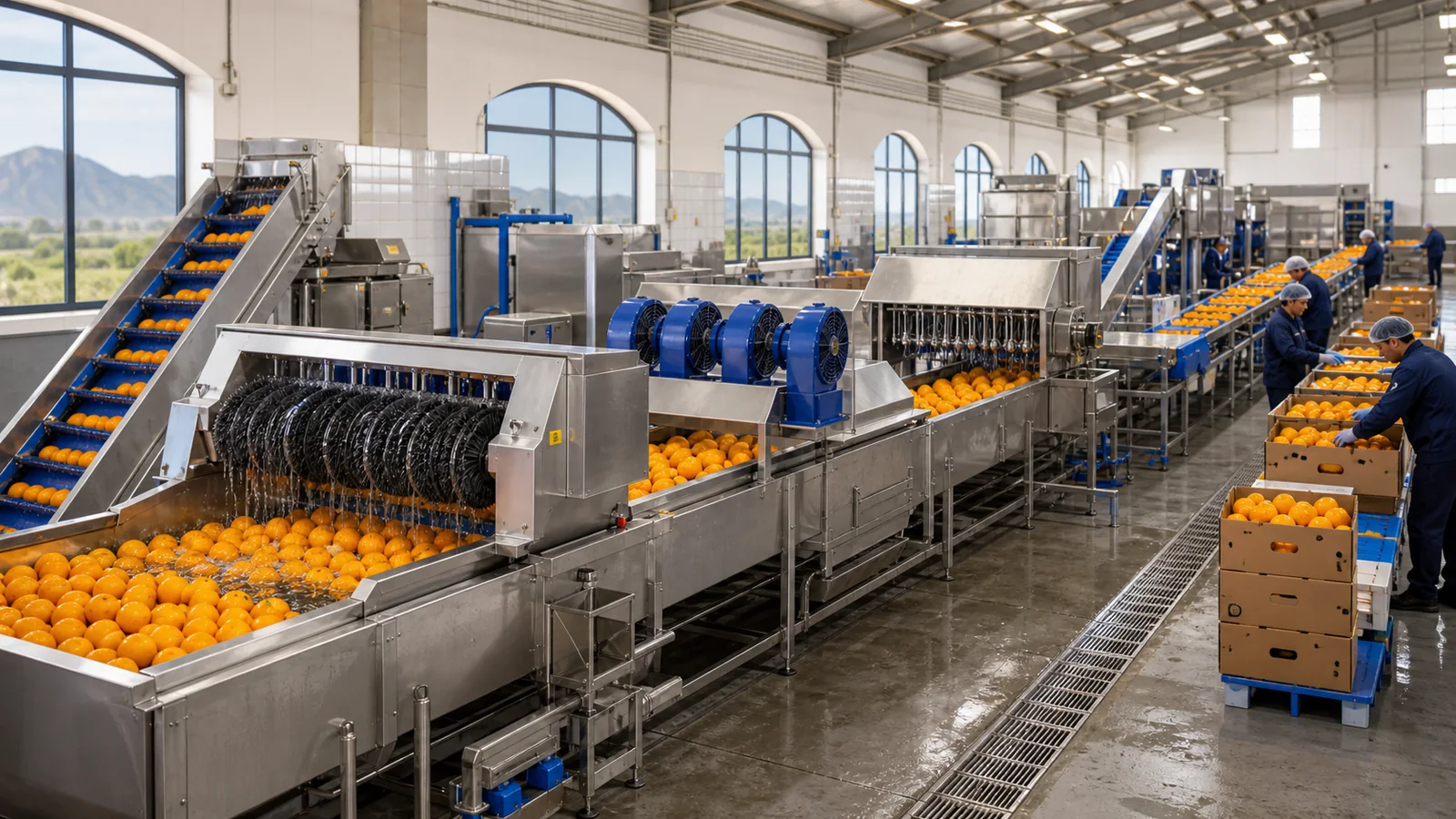
Citrus lines can classify by color and diameter, inspect external and internal defects, and measure sugar content and acidity with the selected optical and near-infrared package. Supporting modules can include drenchers, case tippers, selection conveyors, waxing, brushing, drying tunnels, box filling, electronic scales, netting, and clipping.
This means an RFQ should not simply say “citrus sorting line.” It should state whether the facility needs washing, treatment, waxing, drying, external optical grading, internal quality analysis, weight or count filling, netting, clipping, box filling, pallet preparation, traceability, and cold-store integration.
Bulk weighing and filling configurations can automatically dose 5–50 kg packs for potatoes, onions, carrots, radishes, and similar produce into plastic crates, nets, sacks, or bags.
Those specifications belong to that documented weighing/filling machine context. They should not be presented as the range of every optical produce grading and packing line grader or packing line. In a root-vegetable project, buyers should separately define soil and foreign-material handling, abrasion, product diameter distribution, target pack weight, legal metrology requirements, acceptable giveaway, net or bag specification, and upstream/downstream conveyor control.
The cherry hydrocooling module uses 0–4 °C process water, closed-loop recirculation, filtration, optional disinfection, and a modular tunnel layout. The thermal design is based on incoming fruit temperature, target pulp temperature, residence time, product load, water-to-product ratio, refrigeration duty, sanitation control, and water-quality management.
Hydrocooling performance is specified through measured fruit-pulp temperature, cooling uniformity, residence time, water hygiene, and post-cooling quality rather than a generic shelf-life percentage. The project defines incoming fruit temperature, target pulp temperature, residence time, water-temperature stability, flow distribution, microbiological control, filtration, disinfection method, water replacement, condensate and drainage management, and temperature measurement points.
Optical grading architecture distinguishes external quality analysis from internal quality analysis.
External multispectral inspection can include:
The external-inspection sensor package can be configured for apple, stone fruit, kiwi, citrus, pear, mango, tomato, avocado, onion, lemon, cherry tomato, pomegranate, and other products after crop- and variety-specific validation. Camera geometry, lighting, spectral bands, presentation rollers, defect library, thresholds, and ejection timing are tuned for the actual product.
A buyer should request a crop-and-variety-specific defect matrix. “AI grading” is not an acceptance criterion. The project should name each commercial grade and each defect class, define minimum visible defect size where relevant, provide representative samples, and agree how false rejects and missed defects will be measured.
Near-infrared internal-quality analysis can measure BRIX or sugar level and acidity at reference processing rates of up to 22 fruits per second, subject to crop, fruit size, lane count, presentation, and acceptance criteria.
Near-infrared internal-defect detection can be configured for apples, pears, onions, and related produce, with reference capacities above 500 fruits per minute, 2–10 lanes, fruit from 40 mm diameter, and multiple quality classes. Project acceptance uses representative samples and sustained line loading.
These module-level figures must not be represented as complete packhouse throughput. A complete line can be limited by infeed, singulation, camera presentation, ejection, packing, box supply, palletizing, labor, changeovers, or cold-store logistics.
Instead of asking only for “tonnes per hour,” AgriTech.tr recommends defining a capacity envelope:
| Capacity variable | Example procurement definition |
|---|---|
| Incoming product | Named crop, variety, harvest condition, size distribution, temperature, and maximum field debris or wet-product condition. |
| Grade mix | Expected percentage in each commercial grade, reject percentage, and number of simultaneous outlets. |
| Product handling | Maximum permitted drop height, transfer count, bruising or damage test, and accumulation time. |
| Throughput | Sustained tonnes/hour or pieces/hour at the agreed grade mix for a defined test duration. |
| Packing mix | Percentage of product going to each box, tray, punnet, net, sack, bag, count-fill, or weight-fill format. |
| Changeover | Maximum time to change variety, grade recipe, pack format, label, or customer order. |
| Availability | Planned operating hours, maintenance window, critical-spares strategy, and target technical availability. |
| Saleable output | Accepted packed product per hour after rejects, rework, downtime, pack changes, and quality holds. |
This prevents a high mechanical headline capacity from being mistaken for the facility’s real export-ready output.
For a new optical or electronic grading project, the acceptance plan should be agreed before manufacturing is complete.
A practical test can include:
The exact acceptance method must be adapted to the crop and contract, but the principle is simple: a demonstration video is not a substitute for a written acceptance protocol.
Packing automation can combine box filling, packing tables, punnet filling, robotic packing, fruit orientation, final optical quality control, weighing, netting, clipping, conveying, and pallet wrapping in one coordinated line.
For a Türkiye packhouse project, the buyer should document:
This is particularly important for exporters serving several customers with different grade names and pack formats in the same week.
The traceability layer follows product from reception to warehouse dispatch using barcode, QR or RFID identification, real-time integration, reports, intermediate-stock control, and automated logistics.
Traceability software and packing automation are optional project modules. The signed quotation itemizes licenses, terminals, scanners, printers, databases, ERP/WMS interfaces, support services, data ownership, and acceptance tests.
Before buying, ask:
A technically capable grader can still underperform in a poor facility layout. Before contract signature, request a dimensioned line drawing and review:
The RFQ should also identify who is responsible for civil works, mezzanines, drains, utilities, electrical distribution, network cabling, compressed air, refrigeration interface, safety guarding, local permits, and final machine integration.
Lifecycle support is structured around commissioning, operator and maintenance training, a preventive-maintenance plan, safe remote assistance, critical spare parts, peak-season escalation, response targets, and software support. The contract identifies the service location, covered labor and travel, stocked items, lead time for non-stock parts, remote-access controls, and responsibility during the buyer’s production season.
That is a relevant procurement signal, but buyers still need project-specific service terms. Ask for:
A line that stops for two days during a six-week cherry campaign has a different business risk from a line with a long annual operating season. Service should therefore be evaluated against the crop calendar.
The sourcing brief can be used to define the application, technical interfaces, documentation, and service requirements before supplier research begins.
For guidance on defining capacity, optical grading requirements, internal quality analysis, packing automation, traceability, hydrocooling, pallet logistics, FAT/SAT criteria, or supplier-comparison questions, contact info@agritech.tr.
The cover and in-article photographs provide fruit-handling and packhouse context and are used under the Pexels License. Photographer and source credits are retained in the reference section.
Project capacity, grading accuracy, defect-detection performance, product damage, labor savings, waste reduction, shelf-life effects, line availability, price, warranty, and service response should be confirmed in project-specific documents and acceptance tests.
AgriTech.tr can structure the technical requirement and compare current supplier responses for the buyer’s project. Installation, commissioning, operator training, warranty, spare-parts, and after-sales scope must be confirmed in each supplier quotation. The final scope should be documented against the approved application, capacity, site conditions, destination, and delivery schedule in the selected supplier quotation and contract.
The sources, methods, and context used to prepare this page.
Technical reference used for system specification, project engineering, and procurement planning.
Technical reference used for system specification, project engineering, and procurement planning.
Technical reference used for system specification, project engineering, and procurement planning.
Technical reference used for system specification, project engineering, and procurement planning.
Technical reference used for system specification, project engineering, and procurement planning.
See where the information came from and what must still be confirmed with a supplier.
Independent guide
AgriTech.tr prepared this explanation and comparison guidance.
Planning values
Useful starting points, not a guaranteed final configuration.
5 public sources
Public sources support the technical overview. Current prices, availability, and commercial details still need confirmation.
Supplier-provided claims
No supplier-provided claim is represented in this evidence profile.
Document-verified information
No underlying verification record is attached to this listing.
Listing images
Images are illustrative and may not show the final sourced configuration.
Post-Harvest, Packing & Quality Handling
TürkiyeA gentle cherry packhouse line combining controlled infeed, optional hydrocooling, optical size and quality grading, stem-conscious transfers, weighing, packing and lot traceability.
Supplier and commercial terms require current confirmation
Post-Harvest, Packing & Quality Handling
TürkiyeA modular citrus packhouse line for reception, washing, brushing, controlled treatment, drying, permitted coating, optical and weight grading, flexible packing and lot-level records.
Supplier and commercial terms require current confirmation
Post-Harvest, Packing & Quality Handling
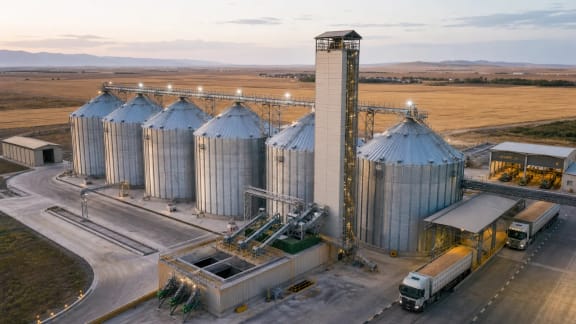
TürkiyeA turnkey bulk-grain project combining intake, pre-cleaning, weighing, galvanized flat- or hopper-bottom silos, conveyors, aeration, temperature and level monitoring, dust control and low-residue unloading.
Supplier and commercial terms require current confirmation