Independent guide
AgriTech.tr prepared this explanation and comparison guidance.
 AgriTech.trTechnologies
Technologies
Practical guides for understanding and comparing agricultural products and equipment.
Fixed-frame precision planting equipment
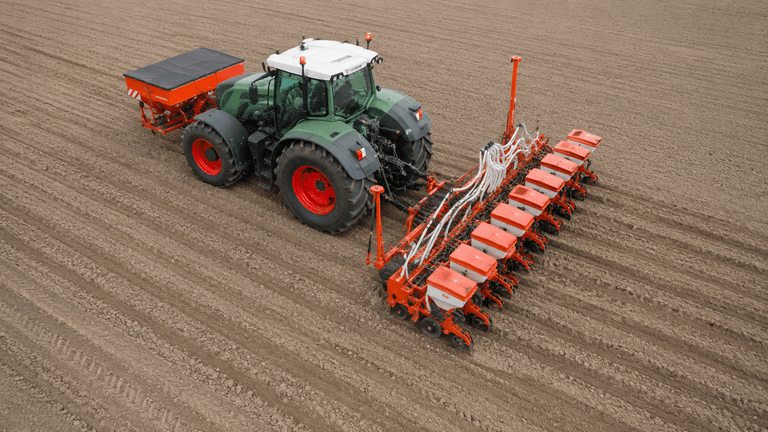
A configurable fixed-frame precision planter for accurate row placement, combining coulter openers, crop-specific metering, adjustable row arrangements, fertilizer and microgranule options, tractor matching, depth control, and field acceptance criteria.
Supplier location
Türkiye
Guide type
Buying guide
Last reviewed
21 Jul 2026
AgriTech.tr prepared this explanation and comparison guidance.
Useful starting points, not a guaranteed final configuration.
Public sources support the technical overview. Current prices, availability, and commercial details still need confirmation.
Fixed-frame precision planting equipment
The main technical details to review and confirm when comparing supplier options.
Fixed-frame coulter precision planters from 2 to 12 rows
Maize, sunflower, sugar beet, cotton, soybean, and other seeds matched to a validated disc and metering setup
Adjustable and configuration-dependent; defined with crop, row count, frame width, transport limit, and field plan
Fertilizer placement, microgranule metering, seed monitoring, hydraulic or PTO fan, markers, transport kits, and larger hoppers
Defined for row count, loaded weight, soil resistance, terrain, speed, fan demand, ballast, and tractor; allow approximately ±20% variation around reference values
The main technical details to review and confirm when comparing supplier options.
Practical details that help people compare options.
Precision planting of maize and sunflower
Sugar beet, cotton and soybean row planting
Planting with optional fertilizer placement
Microgranule application when specified
Two- to twelve-row configurations for different tractor and field plans
Confirm the supplier, final configuration, certifications, price, delivery, and warranty before you buy.
The sources, methods, and context used to prepare this page.
This profile defines a sourcing requirement for fixed-frame coulter precision planter. Suitable suppliers, origin, availability, and commercial terms are confirmed for the buyer’s project. The sourcing brief is structured around capacity, application, operating environment, required standards, destination, and delivery scope; the exact configuration requires supplier confirmation.
The fixed-frame coulter precision planter is configured from two to twelve rows for maize, sunflower, sugar beet, cotton, soybean, and other compatible seeds. Coulter openers, crop-specific seed discs, adjustable row spacing, fertilizer placement, microgranule metering, vacuum generation, monitoring, transport equipment, and tractor matching are selected as one engineered package.
The planter is configured by row count, row spacing, transport width, operating weight, tyre package, seed and fertilizer hopper capacity, and tractor power. A representative four-row arrangement uses 70–75 cm or 90 cm spacing, approximately 300 cm transport width, about 670 kg minimum weight, and 60–70 hp indicated power; a fertilizer-equipped four-row arrangement is approximately 880 kg. Final values follow the selected frame, hopper package, soil, slope, and tractor.
The equipment package can include coulter row units, crop-specific seed discs, PTO-driven fan, area counter, and hydraulic markers, with optional microgranule metering, seed-monitoring sensors, transport or trailed kits, hydraulic fan, and larger fertilizer hoppers. Required tractor power can vary by roughly ±20% with soil resistance, terrain, ballast, operating speed, vacuum demand, and tractor configuration.
Define crop, seed size distribution, treatment/coating, target population, row spacing, field residue, tillage system, soil texture, slope, tractor linkage and hydraulic/PTO capacity. Ask for the metering mechanism and singulation adjustment, available seed discs, downforce and depth control, fertilizer placement, microgranule calibration, fan requirements, row shutoff or monitor options and transport compliance. Check total loaded mass and axle/linkage limits rather than using empty weight alone.
A field acceptance test should measure skips, doubles, within-row spacing, depth, emergence uniformity, fertilizer rate, seed damage, turning/headland operation and calibration repeatability at several realistic speeds. Record soil moisture and seed lot so results are reproducible. Obtain operator and parts manuals, lubrication and wear schedule, critical spares, service tooling, warranty, assembly/commissioning and export packing.
Field-level singulation, skips, doubles, seed-spacing variation, maximum operating speed, hectare capacity, fuel demand, durability, and wear-part life are defined with the selected seed, disc, soil, target population, and field acceptance protocol. Price, lead time, warranty, and service scope are documented in the project quotation.
AgriTech.tr can structure the technical requirement and compare current supplier responses for the buyer’s project. Installation, commissioning, operator training, warranty, spare-parts, and after-sales scope must be confirmed in each supplier quotation. The final scope should be documented against the approved application, capacity, site conditions, destination, and delivery schedule in the selected supplier quotation and contract.
The sources, methods, and context used to prepare this page.
Technical reference used for system specification, project engineering, and procurement planning.
Reference sources
See where the information came from and what must still be confirmed with a supplier.
Independent guide
AgriTech.tr prepared this explanation and comparison guidance.
Planning values
Useful starting points, not a guaranteed final configuration.
1 public source
Public sources support the technical overview. Current prices, availability, and commercial details still need confirmation.
Supplier-provided claims
No supplier-provided claim is represented in this evidence profile.
Document-verified information
No underlying verification record is attached to this listing.
Listing images
No listing image is used as product evidence.